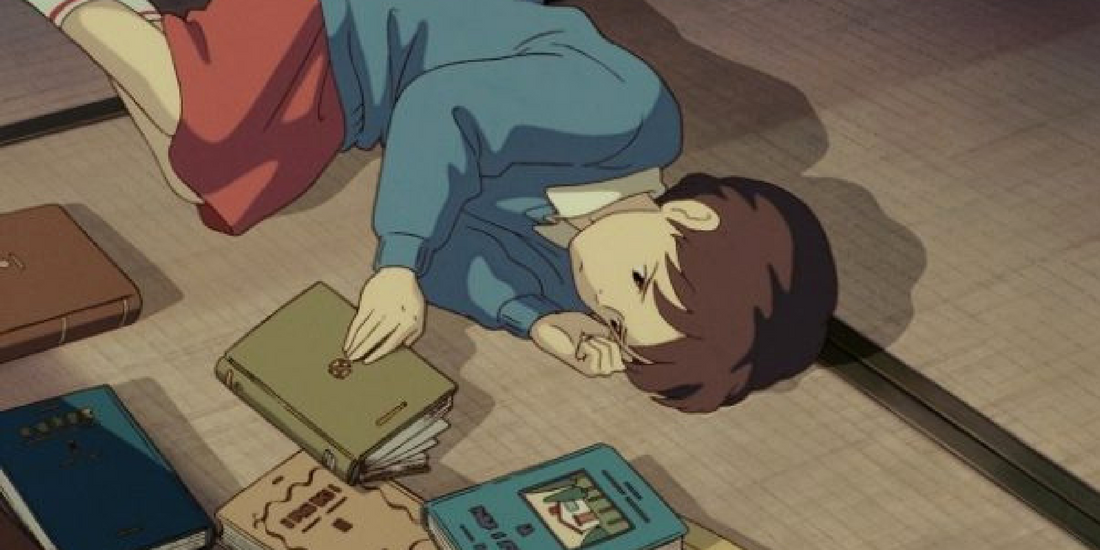
The film is conscious of the class dimensions to all this. Shizuku lives in a cramped apartment where she has to share a room with her older sister. Her lovesick best friend lives in a mansion by comparison, and her paramour Seiji also commutes from a fancier neighbourhood. Shizuku's mother is studying for an MA and her sister is saving money so she can move into her own apartment – both are focused on getting on in the world and find Shizuku's diversions from her schoolwork baffling. Her father is a librarian, and content with his job and position in life, which allows him to be more supportive of his daughter's artistic development. But it's clear that Shizuku doesn't have some of the advantages of her school friends, which stack the odds against her succeeding as a writer.
25.4.20
Whisper of the Heart (If You Listen Closely)
This is one of Miyazaki's finest works. He wrote the script, but the director is Yoshifumi Kondō – a rising star at Studio Ghibli who tragically died before he could make more films. It's a mostly realistic story about a bright high school girl who has to navigate a love triangle, the pressures of studying and her own budding abilities as a creative writer. The love triangle is almost a Shakespearian comedy, with lots of characters liking the wrong person or not realising who they really like. It culminates in a powerful scene in which Shizuku rejects a suitor, after which this plot strand is largely abandoned. Instead the film turns to explore the tension between artistic ambition and the daily demands of life, school and work.
Shizuku's relationship with her mysterious classmate (who hangs out with his antiquarian grandfather and wants to learn how to make violins in Italy) turns into an intellectual partnership as much as it is a young romance. Exposure to this new household filled with intriguing objects and where people have the opportunity to develop their creative talents is a spur for Shizuku to finish writing her own first story, to the point where she has to abandon studying for her exams. The effort is not cost-free – Shizuku's family become concerned about her behaviour and her grades. But in a heartwarming scene Shizuku's father intervenes on her behalf, giving her the support she needs to complete her personal project.
The film is conscious of the class dimensions to all this. Shizuku lives in a cramped apartment where she has to share a room with her older sister. Her lovesick best friend lives in a mansion by comparison, and her paramour Seiji also commutes from a fancier neighbourhood. Shizuku's mother is studying for an MA and her sister is saving money so she can move into her own apartment – both are focused on getting on in the world and find Shizuku's diversions from her schoolwork baffling. Her father is a librarian, and content with his job and position in life, which allows him to be more supportive of his daughter's artistic development. But it's clear that Shizuku doesn't have some of the advantages of her school friends, which stack the odds against her succeeding as a writer.
While the film is a melodrama, it's refreshingly grounded about these obstacles and burdens. The romance between Shizuku and Seiji is founded on an acknowledgement of their particular creative interests, and the understanding that they are to be nurtured despite the anguish of separation that might involve. It is a partnership in which each supports the other to fulfill themselves. The film's final scene, in which Shizuku and Seiji race up a hill to catch the sunrise, becomes a metaphor for their relationship, with Shizuku getting off Seiji's bike to push together towards their shared goal.
The film is conscious of the class dimensions to all this. Shizuku lives in a cramped apartment where she has to share a room with her older sister. Her lovesick best friend lives in a mansion by comparison, and her paramour Seiji also commutes from a fancier neighbourhood. Shizuku's mother is studying for an MA and her sister is saving money so she can move into her own apartment – both are focused on getting on in the world and find Shizuku's diversions from her schoolwork baffling. Her father is a librarian, and content with his job and position in life, which allows him to be more supportive of his daughter's artistic development. But it's clear that Shizuku doesn't have some of the advantages of her school friends, which stack the odds against her succeeding as a writer.
15.4.20
Ferris Bueller's Day Off
If you are lucky enough not to have to play by the rules, why should you? This film is a diatribe against the politics of envy – if you feel resentment at other people’s good fortune then the problem is your own. Those that become obsessed by it (like the hapless Ed Rooney) end up ruined, whereas Bueller’s sister manages to let go, and bag herself a smooch with Charlie Sheen in the process.
Bueller is wired for success despite his slacker attitude. Preternaturally self-confident, a wizard with technology, and from a comfortably middle-class background, he’ll no doubt end up making and losing millions in the 90s dot com bubble. The film notes the inadequacies of high school education (a mixture of dull rote-learning and horrific army-style exercise) and suggests that the ingenuity and creativity inherent in spinning your way through a day off is a better use of your time. Bueller’s father works in advertising and it looks like Bueller’s talent for bullshitting is inherited. A large detached house in the suburbs and a brood of incorrigible kids beckons.
Matthew Broderick does his best to make this shyster as lovable as possible. Perhaps having some experience of that European socialism Bueller dismisses so breezily I am somewhat immune to his charms, and find the film’s celebration of individualistic free-riding a bit distasteful. Part of the fantasy of this film is that its YOLO attitude never has negative consequences, when in fact civilisation is built on the ability to adhere to rules even if they don’t benefit you and to sacrifice today’s pleasures for future rewards. Bueller’s day off is a holiday from the world. It’s a break to enjoy the sights before the speed of life takes over again.
It’s telling that Hughes’s attempts to imbue the character with some sort of fellow-feeling ring false. Bueller volunteering to take the rap for his friend trashing his father’s car is supposed to be a heartfelt moment, but could just as well be a double bluff playing on Cameron’s emotional instability. You can’t escape the suspicion that everyone is a mark to him.
Hughes touches on some quite dark themes of depression and suicide with Cameron’s character, but you never get the sense that Bueller actually cares about him. His diagnosis that Cameron just needs more sexual experience in order to be able to assert himself is both sexist and wide off the mark. There's also a deeply weird moment where Cameron leering at Bueller’s girlfriend is framed as some sort of moment of personal growth. Cameron feels like a character from another film – someone with demons to exorcise who unfortunately has only Bueller and Hughes to help him.
It's a self-indulgent film, with expensive helicopter shots, an arty montage sequence in a gallery, and an over-the-top parade scene that feels like the film has momentarily turned into a musical. Although it is still a collection of parts, the focus on a single character who directly lectures his audience makes for a less disjointed film than something like The Breakfast Club. Ed Rooney is a cartoon villain, and his attempts to catch Bueller prefigures Hughes's script for Home Alone. The fact that such childishness sits alongside scenes in which Cameron and Sloane walk around Chicago admitting their existential terror at the prospect of the future makes this a weird hybrid – both a kids comedy and a teen drama. Much like Bueller's outrageous schemes, it just about manages to hang together.
Bueller is wired for success despite his slacker attitude. Preternaturally self-confident, a wizard with technology, and from a comfortably middle-class background, he’ll no doubt end up making and losing millions in the 90s dot com bubble. The film notes the inadequacies of high school education (a mixture of dull rote-learning and horrific army-style exercise) and suggests that the ingenuity and creativity inherent in spinning your way through a day off is a better use of your time. Bueller’s father works in advertising and it looks like Bueller’s talent for bullshitting is inherited. A large detached house in the suburbs and a brood of incorrigible kids beckons.
Matthew Broderick does his best to make this shyster as lovable as possible. Perhaps having some experience of that European socialism Bueller dismisses so breezily I am somewhat immune to his charms, and find the film’s celebration of individualistic free-riding a bit distasteful. Part of the fantasy of this film is that its YOLO attitude never has negative consequences, when in fact civilisation is built on the ability to adhere to rules even if they don’t benefit you and to sacrifice today’s pleasures for future rewards. Bueller’s day off is a holiday from the world. It’s a break to enjoy the sights before the speed of life takes over again.
It’s telling that Hughes’s attempts to imbue the character with some sort of fellow-feeling ring false. Bueller volunteering to take the rap for his friend trashing his father’s car is supposed to be a heartfelt moment, but could just as well be a double bluff playing on Cameron’s emotional instability. You can’t escape the suspicion that everyone is a mark to him.
It's a self-indulgent film, with expensive helicopter shots, an arty montage sequence in a gallery, and an over-the-top parade scene that feels like the film has momentarily turned into a musical. Although it is still a collection of parts, the focus on a single character who directly lectures his audience makes for a less disjointed film than something like The Breakfast Club. Ed Rooney is a cartoon villain, and his attempts to catch Bueller prefigures Hughes's script for Home Alone. The fact that such childishness sits alongside scenes in which Cameron and Sloane walk around Chicago admitting their existential terror at the prospect of the future makes this a weird hybrid – both a kids comedy and a teen drama. Much like Bueller's outrageous schemes, it just about manages to hang together.
16.3.20
Night of the Comet
A foundational influence on Buffy the Vampire Slayer, so obviously I watched it when it came up on Netflix. It's a 1980s horror-comedy which isn't particularly scary and where the comedy is partly about the film's own knowingness about the genres it's operating in. So you can see why Joss Whedon might have been into it. The film starts off in a cinema and has several key scenes in a radio studio, and both the movie posters that decorate the sets and the brash pop music soundtrack (mostly diegetic) provide a metacommentary on the unfolding plot. That distancing effect crosses into the dialogue. There is some (unconvincing) acknowledgement of the trauma of having the world end, but for the most part the survivors react to the situation with a healthy amount of ironic detachment.
Eberhardt's inspiration for the script came from joking around with teenage girls about what they would do in a zombie apocalypse, and reflecting the fact that his respondents were mostly worried about not being able to date anymore. The sense of possibility inherent in a largely automated world where the adults have disappeared is at the heart of the film and is highlighted by its ending, where the guns are put away and a new and happier family unit is established amidst the ruins of the city. The apocalypse purifies the world of absent fathers and abusive mothers, and allows for the creation of something new. You can see the impact on Whedon when he describes most of his projects as being about the formation of alternate families.
Part of the film's purpose is to demonstrate that typical California girls are tougher and more resourceful than the horror movie stereotypes would have you expect. They can be sexually active, obsessed with arcade games or on the cheerleading squad and still fight off zombies. The big twist in the film is also gendered, in that the government agent you expect to be evil but who ends up saving the kids is a woman overruled by her male superiors. The film has a refreshingly uncondescending approach to its hard-bitten female characters. It's yet another thing Whedon will have picked up on when creating Buffy.
7.3.20
Fleabag
I've been trying to work out why this doesn’t irritate me the way Lena Dunham’s Girls did, given the initial similarities. For all of Dunham's self-flagellation, there was nonetheless a sense of entitlement to her project – ultimately she does want to be the "voice of a generation" despite the claim being sheathed in irony within the show. Her erasure of people of colour is all the more damning as a result. Fleabag is also white and middle class (and to my eyes the design of her flat doesn't quite square with the economics of running a failing small business in London), but she has no pretensions to being destined for great things. She's just another lost soul in the city.
The stakes are also higher than anything Hannah Horvath has to deal with. Both characters have a lack of self-esteem which lead them to make poor romantic choices (to put it mildly). But with Fleabag, this is presented as a kind of yawning crater opened up as a result of multiple bereavements, made worse by the fact she blames herself for one of them. The show is funny in the typical excruciating British comedy-of-manners way, but it's just as much a dark drama about someone's life falling apart, and their attempt to clutch desperately at things that might put it back together.
That's the first season anyway. The second one is about the upswing after reaching the pits of despair. The cleverest part of the show is that it finds a way to provide a psychological explanation for its signature technical innovation – Phoebe Waller-Bridge's masterful asides to camera. I imagine this technique grew out of the show's origins as a one-woman play, but there was always something slightly incongruous about a deeply lonely person having this animated inner dialogue with the audience. Who really is she talking to?
The introduction of a love interest who is a priest brings this out. The dramatic tension inherent in a sexually voracious character falling in love with someone sworn to abstinence is obvious. But the connection the two characters form is built on this propensity to communicate with invisible people. The show draws this out explicitly – the priest is the only one who can sense Fleabag's asides, even if he can't overhear them. They are prayers, and we are Fleabag's chorus of gods.
The arc of the show thus becomes Fleabag's conjuration of an army of silent companions that bear witness to her struggles – an imaginary source of comfort and validation she cannot get from her deeply messed up family. The show ends with the realisation that she doesn't need us anymore – unlike the priest, who chooses God over love and in doing so is revealed to be a coward. The show might break off the affair at the end, and be seen to end on a downer. But there is a triumph in Fleabag's final wave goodbye to us. She is casting off her crutches and is finally able to cope on her own.
19.2.20
Only Yesterday (Memories Come Tumbling Down)
A carefully-wrought, subtle drama from Studio Ghibli's other great maestro Isao Takahata. It reminded me a bit of George Eliot's The Mill on the Floss, in that the depiction of the protagonist's childhood puts her adult character in perspective, although the connections are elliptical and sometimes mysterious. Nevertheless a picture emerges of a spirited young girl who is overlooked, insulted and on one occasion straight-up abused by her family – not out of spite or ill-will, but because her parents are tired and confused and don't have the emotional resources to support their youngest child. The result is an outwardly successful young woman with a job in Tokyo who feels like a ghost.
The solution to Taeko's alienation is a holiday to the countryside, where she joins the villagers in their back-breaking agricultural work. The family relationships she discovers there go some way towards mending the traumas buried in her past. The contrast between town and country is a well-worn trope, but the most impressive thing about the film is that it always endeavours to strike a balance between idealism and realism. An example is the organic farmer lecturing on the importance of respecting nature, but also admitting to using weedkiller because there just isn’t enough agricultural labour in modern times to pull the weeds out by hand.
Another example comes at the end when the possibility is raised of Taeko giving up life in the city and finding romance in the countryside. She treats this as a ridiculous suggestion and describes it as something out of a film. The irony, of course, is that this is a film, and in the final moments she does turn back. But this surrender is presented as a fantasy – it's part of the credits sequence where the music swells and the ghosts of the past appear to guide Taeko to happiness. It's where the film abandons verisimilitude and turns overtly film-like, and the balance tips into unadulterated romanticism. It feels like something that happens after the story has ended and Taeko goes back to Tokyo. I suspect Takahata wanted to give his audience a reward for persevering with the difficult work of a woman coming to terms with her past. But that reward is offered grudgingly, presented as a flight of fancy – almost an afterthought. As Taeko says, it's something that happens in films but is impossible in real life.
30.1.20
“Some whys, if you follow them far enough, lead over the rim of reality,” replied the silver one. “I have sought knowledge beyond the dreams of ordinary men; I have ventured far into the darkness that encirles mind and stars. But now, midmost of the pitchy windings of that fearsome labyrinth, I find myself suddenly at my skein's end. The tyrant powers who ignorantly guard the secret of the universe without knowing what it is, have scented me. Those vile wardens of whom Ningauble is the merest agent and even Ormadz a cloudy symbol, have laid their traps and built their barricades. And my best torches have snuffed out, or proved too flickery-feeble. I need new avenues of knowledge.”
He turned upon them eyes that seemed to be changing to twin holes in a curtain. “There is something in the inmost core of you, something that you, or others before you, have close-guarded down the ages. Something that lets you laugh in a way that only the Elder Gods ever laughed. Something that makes you see a kind of jest in horror and disillusionment and death. There is much wisdom to be gained by the unravelling of that something.”
– Fritz Leiber, ‘Adept's Gambit’, Swords in the Mist
31.12.19
Favourite music of 2019
Shorter list this year as I only have time to write up nine fave songs (which as usual largely serve as stand-ins for their respective albums). I do list some more honourable mentions at the bottom.
The spirit of Nicki Minaj is strong with this one. Part of Minaj's challenge to the male-dominated genre of hip hop is to insist that her work contain not only virtuosic rapping ability but also sounds and signifiers traditionally coded as feminine, and have those latter elements be as garish as possible – hence the prevalence of autotuned singing, bubblegum pop and the colour pink. The reaction to tracks like 'Gun Shot', 'Super Bass' or 'Stupid Ho' from scene gatekeepers demonstrates the challenge such a project entailed. But the world has changed, and artists like Doja Cat have moved into the space Minaj opened up. The album Hot Pink (her favourite colour as well as a signpost to the influence of Minaj's Pink Friday) is great throughout, but I picked this cut because of the disorientating way it co-opts the often sexist and exploitative language of the pimp-prostitute relationship to speak about friendship and loyalty, and in doing so showing how hip hop can be bent and shaped to cater to new communities of listeners.
Charly Bliss trade in the sublime 90s pop-punk of their first album for polished synth-pop straight out of the CHVRCHES rulebook. Given that CHVRCHES already exist and no one could touch Guppy at its peak, I can't help but feel disappointed at this development. First single 'Capacity' does manage to recapture some of the highs of their earlier work, particularly once it gets to the bridge, which is tailor-made for lasers over the main stage of a festival.
The disappointment with Pitchfork's big 2010s lists is that amalgamating the preferences of informed listeners will inevitably favour artists with larger profiles, because those are the names that will appear most often across individual lists. And this constructs an account of the decade that focuses on the most influential music, rather than necessarily the best. Dawn Richard has probably produced the most consistently excellent R&B of the last 10 years, but by various twists of fate her music has bubbled under the surface rather than be recognised for the ambitious suite of work that it is. Anyway, this year's new breed isn't even in the top tier of records she's put out as a solo artist, and it's still essential. I saw her in London in April and her rendition of 'vultures' brought the entire house down.
It's probably some sort of rule that rock albums need to end on a series of escalating climaxes piling up on top of each other until they all collapse. This is exactly what happens here – with giant drums and the grandest of pianos pushing up bigger and bigger swells of noise, before unleashing a barrage of blissful guitar solos. The crescendo that accompanies the triumphant line 'I'm in love with you' is followed by a long denouement, as if invoking the work that follows such a declaration to keep the relationship strong over time. Even if that emotional peak is never reached again, there is satisfaction still in the song gradually unspooling outwards, settling into a steady state groove of contentment.
'Gone' is probably a better song, but this beatless solo cut from her very good self-titled album this year just sounds HUGE. Slightly ridiculous comparison, but it's the sort of chest-beating all-caps autotuned melodrama found in something like Lil Durk's drill anthem 'This Ain't What You Want'. The influence of contemporary rap is felt also in the lyrics, which Charli basically freestyled during a long and frustrating session in the studio. A.G. Cook builds a cavern of icy blasting winds at the centre of which Charli bellows and shrieks her deepest and darkest. But despite the doubts about fake friends and failed relationships there's a grim defiance undergirding the track and gives it a strange kind of uplift – big attitude, I don't wanna compromise. Charli is owning her insecurities, and it doesn't sound like they will ever get in her way.
In case you couldn't tell, Alyse Vellturo is annoyed. The cause of her anger is communicated pretty directly in the chorus – sitting here feeling sorry for somebody you hate when you know it's wrong – and those lines sound like they're being sung through gritted teeth. And yet all the mounting rage and frustration of the situation is channelled into a very tightly put together pop song with a cheery dual-guitar riff that slices through at key moments. It's a skillfully wound contraption – sparks flying from the effort of containing all that energy within yourself, and transforming it into something new and delightful.
Slightly ashamed to be falling for an album that could easily be factored into a general critique of soulful background music designed to slot neatly into Spotify playlists – all idiosyncrasies treated as irritants and ruthlessly shaved off to produce a smooth, mellow flow of bland ambience that goes in one ear and out the other. All I can say is that there's something captivating about Immunity that makes it stand out regardless of how easily it goes down. Its best tracks create a wonderful tension between the mumbled, barely audible vocals and the roiling emotions they partly conceal. 'North' is not an obvious pick from the album, but as a tale of young lust on the edge of revealing itself, and set to a driving motorik beat, it is entrancing like little else this year. The slight distortion on the final chorus, corroding the vocal yet further with the desperation of desire, is just the right final touch.
A lattice of interweaving guitar parts soundtrack the back and forth between two interior monologues cataloguing the gradual disintegration of a relationship. Emo grown up, grown tired, grown depressed and despondent, but this being American Football there's still this romantic yearning for a connection despite all the obstacles in the way. It's an unhappy ending – the two voices only occasionally harmonise before branching off in different directions. But the music itself is so hypnotically beautiful that it could fool you into thinking there's still some hope left.
Some other records I liked this year
Beats:
Octo Octa - Resonant Body
Pugilist - Blue 06
TC4 - Ola EP
Kara Marni & Champion - All Night, Pt 1
Air Max '97 - Ice Bridge
Kasper Marott - Drømmen om Ø (Forever Mix '19)
Skee Mask - Iss004 EP (the bits that sound most like Compro)
Plaid - Maru (Skee Mask Remix)
Christoph De Babalon - Hectic Shakes EP
Guitars:
Great Grandpa - Four of Arrows
Grime and progeny:
Bru-C & Window Kid feat. Pubman, KDot, Kamakaze & Devilman - Bits (Remix)
Durrty Goodz (prod. Beekay) - Brexit
Pinch & Trim - That Wasn't It
Cadell feat. Sense & Delusion (prod. Wize) - Don't Lack
No Hats No Hoods compilation - London To Addis
Slimzos Recordings compilation - Time
Chill:
Meitei - Komachi
Leif - Loom Dream
Akasha System - Echo Earth
Kornél Kovács - Stockholm Marathon
Robag Wruhme - Venq Tolep
9. Doja Cat (additional production Yeti Beats) - Bottom Bitch
The spirit of Nicki Minaj is strong with this one. Part of Minaj's challenge to the male-dominated genre of hip hop is to insist that her work contain not only virtuosic rapping ability but also sounds and signifiers traditionally coded as feminine, and have those latter elements be as garish as possible – hence the prevalence of autotuned singing, bubblegum pop and the colour pink. The reaction to tracks like 'Gun Shot', 'Super Bass' or 'Stupid Ho' from scene gatekeepers demonstrates the challenge such a project entailed. But the world has changed, and artists like Doja Cat have moved into the space Minaj opened up. The album Hot Pink (her favourite colour as well as a signpost to the influence of Minaj's Pink Friday) is great throughout, but I picked this cut because of the disorientating way it co-opts the often sexist and exploitative language of the pimp-prostitute relationship to speak about friendship and loyalty, and in doing so showing how hip hop can be bent and shaped to cater to new communities of listeners.
8. Charly Bliss - Capacity
Charly Bliss trade in the sublime 90s pop-punk of their first album for polished synth-pop straight out of the CHVRCHES rulebook. Given that CHVRCHES already exist and no one could touch Guppy at its peak, I can't help but feel disappointed at this development. First single 'Capacity' does manage to recapture some of the highs of their earlier work, particularly once it gets to the bridge, which is tailor-made for lasers over the main stage of a festival.
7. Dawn Richard (additional production D Berg) - vultures | wolves
The disappointment with Pitchfork's big 2010s lists is that amalgamating the preferences of informed listeners will inevitably favour artists with larger profiles, because those are the names that will appear most often across individual lists. And this constructs an account of the decade that focuses on the most influential music, rather than necessarily the best. Dawn Richard has probably produced the most consistently excellent R&B of the last 10 years, but by various twists of fate her music has bubbled under the surface rather than be recognised for the ambitious suite of work that it is. Anyway, this year's new breed isn't even in the top tier of records she's put out as a solo artist, and it's still essential. I saw her in London in April and her rendition of 'vultures' brought the entire house down.
6. Kehlani feat. Musiq Soulechild (prod. SuperDuperBrick & J Young White) - Footsteps
A sparse but knotty production hooks into the corners of the track while Kehlani lays on some real talk to her partner about her need for recognition and support in order to make a relationship work. 'Footsteps' is a frank conversation between two people taking stock on the inadequacies of young love, and how to build firmer foundations for the future. And the harmonising between Kehlanni and Musiq Soulechild at the end signals that a reconciliation has been achieved, holding out the promise that not all broken things are irrecoverable.
5. Mannequin Pussy - In Love Again
It's probably some sort of rule that rock albums need to end on a series of escalating climaxes piling up on top of each other until they all collapse. This is exactly what happens here – with giant drums and the grandest of pianos pushing up bigger and bigger swells of noise, before unleashing a barrage of blissful guitar solos. The crescendo that accompanies the triumphant line 'I'm in love with you' is followed by a long denouement, as if invoking the work that follows such a declaration to keep the relationship strong over time. Even if that emotional peak is never reached again, there is satisfaction still in the song gradually unspooling outwards, settling into a steady state groove of contentment.
4. Charli XCX (prod. A.G. Cook) - Thoughts
'Gone' is probably a better song, but this beatless solo cut from her very good self-titled album this year just sounds HUGE. Slightly ridiculous comparison, but it's the sort of chest-beating all-caps autotuned melodrama found in something like Lil Durk's drill anthem 'This Ain't What You Want'. The influence of contemporary rap is felt also in the lyrics, which Charli basically freestyled during a long and frustrating session in the studio. A.G. Cook builds a cavern of icy blasting winds at the centre of which Charli bellows and shrieks her deepest and darkest. But despite the doubts about fake friends and failed relationships there's a grim defiance undergirding the track and gives it a strange kind of uplift – big attitude, I don't wanna compromise. Charli is owning her insecurities, and it doesn't sound like they will ever get in her way.
3. pronoun - wrong
In case you couldn't tell, Alyse Vellturo is annoyed. The cause of her anger is communicated pretty directly in the chorus – sitting here feeling sorry for somebody you hate when you know it's wrong – and those lines sound like they're being sung through gritted teeth. And yet all the mounting rage and frustration of the situation is channelled into a very tightly put together pop song with a cheery dual-guitar riff that slices through at key moments. It's a skillfully wound contraption – sparks flying from the effort of containing all that energy within yourself, and transforming it into something new and delightful.
2. Clairo (additional production Rostam & Peter Cottontale) - North
Slightly ashamed to be falling for an album that could easily be factored into a general critique of soulful background music designed to slot neatly into Spotify playlists – all idiosyncrasies treated as irritants and ruthlessly shaved off to produce a smooth, mellow flow of bland ambience that goes in one ear and out the other. All I can say is that there's something captivating about Immunity that makes it stand out regardless of how easily it goes down. Its best tracks create a wonderful tension between the mumbled, barely audible vocals and the roiling emotions they partly conceal. 'North' is not an obvious pick from the album, but as a tale of young lust on the edge of revealing itself, and set to a driving motorik beat, it is entrancing like little else this year. The slight distortion on the final chorus, corroding the vocal yet further with the desperation of desire, is just the right final touch.
1. American Football feat. Hayley Williams - Uncomfortably Numb
A lattice of interweaving guitar parts soundtrack the back and forth between two interior monologues cataloguing the gradual disintegration of a relationship. Emo grown up, grown tired, grown depressed and despondent, but this being American Football there's still this romantic yearning for a connection despite all the obstacles in the way. It's an unhappy ending – the two voices only occasionally harmonise before branching off in different directions. But the music itself is so hypnotically beautiful that it could fool you into thinking there's still some hope left.
Some other records I liked this year
Beats:
Octo Octa - Resonant Body
Pugilist - Blue 06
TC4 - Ola EP
Kara Marni & Champion - All Night, Pt 1
India Jordan - DNT STP MY LV EP / WARPER EP
Special Request - VortexAir Max '97 - Ice Bridge
Kasper Marott - Drømmen om Ø (Forever Mix '19)
Skee Mask - Iss004 EP (the bits that sound most like Compro)
Plaid - Maru (Skee Mask Remix)
Christoph De Babalon - Hectic Shakes EP
Guitars:
Great Grandpa - Four of Arrows
Martha - Love Keeps Kicking
Sacred Paws - Run Around The Sun
Origami Angel - Somewhere CityGrime and progeny:
Bru-C & Window Kid feat. Pubman, KDot, Kamakaze & Devilman - Bits (Remix)
Durrty Goodz (prod. Beekay) - Brexit
Pinch & Trim - That Wasn't It
Sidhu Moose Wala, MIST & Steel Banglez feat. Stefflon Don - 47
Shakka feat. Mr Eazi (prod. Banx & Ranx) - Too Bad BadCadell feat. Sense & Delusion (prod. Wize) - Don't Lack
No Hats No Hoods compilation - London To Addis
Slimzos Recordings compilation - Time
Chill:
Meitei - Komachi
Leif - Loom Dream
H.Takahashi - Sonne Und Wasser
Mikron - SeveranceAkasha System - Echo Earth
Kornél Kovács - Stockholm Marathon
Robag Wruhme - Venq Tolep
Kankyō Ongaku: Japanese Ambient, Environmental & New Age Music 1980-1990 (the bits available on digital)
30.12.19
49 films in 2019
There isn't even any point in me listing my favourite new films I've seen this year – it's just Marvel movies and Kechiche's controversial follow-up to Blue is the Warmest Colour, which I thought was good if a bit icky (and the sequel is apparently just icky). I have been going to the cinema, but it's been the Prince Charles and the BFI to watch old films, which are invariably less likely to disappoint than new ones.
And in 2019 I ended up spending a lot of time in the 90s – not just on the big films of the decade (Silence of the Lambs, Dazed and Confused, Scream, The Piano, Boyz n the Hood) but the second tier (Doom Generation, Jackie Brown, Strange Days, Wild Things) which have often proved more interesting. There's a supposed 20-year-rule in pop music revivals where the generation that gains artistic and commercial influence in their 30s bring with them their formative influences as teenagers, a personal version of which seems to be dictating my film-watching habits.
Should also shout out the London Graphic Novel Network film club for many of the entries here, which has provided an excuse to revisit old favourites (Pan's Labyrinth, Children of Men, Lost in Translation, Jennifer's Body, Alien) and argue about them in robust and entertaining terms. Many of the links below are to the conversations conducted over email and then published on the site.
New:
Abdellatif Kechiche - Mektoub, My Love: Canto Uno [link]
Anthony and Joe Russo - Avengers: Endgame
Jon Watts - Spider-Man: Far From Home [link]
Anna Boden / Ryan Fleck - Captain Marvel [link]
Old:
Guillermo del Toro - Pan's Labyrinth [link]
Alfonso Cuarón - Children of Men [link]
Sofia Coppola - Lost in Translation [link]
Kathryn Bigelow - Strange Days [link]
Alejandro González Iñárritu - Birdman (or, The Unexpected Virtue of Ignorance) [link]
Orson Welles - Citizen Kane [link]
Takashi Miike - 13 Assassins [link]
Chuck Russell - The Mask [link]
Gaspar Noé - Enter the Void [link]
John McNaughton - Wild Things [link]
David Eggers - The VVitch: A New England Folktale [link]
Jack Hill - Coffy [link]
Howard Hawks - His Girl Friday [link]
Mark Waters - Mean Girls [link]
Martin Scorsese - King of Comedy [link]
Nagisa Oshima - The Sun's Burial [link]
Stanley Kubrick - A Clockwork Orange [link]
Hideaki Anno - Neon Genesis Evangelion / The End of Evangelion [link]
Michelangelo Antonioni - Identification of a Woman [link]
And in 2019 I ended up spending a lot of time in the 90s – not just on the big films of the decade (Silence of the Lambs, Dazed and Confused, Scream, The Piano, Boyz n the Hood) but the second tier (Doom Generation, Jackie Brown, Strange Days, Wild Things) which have often proved more interesting. There's a supposed 20-year-rule in pop music revivals where the generation that gains artistic and commercial influence in their 30s bring with them their formative influences as teenagers, a personal version of which seems to be dictating my film-watching habits.
Should also shout out the London Graphic Novel Network film club for many of the entries here, which has provided an excuse to revisit old favourites (Pan's Labyrinth, Children of Men, Lost in Translation, Jennifer's Body, Alien) and argue about them in robust and entertaining terms. Many of the links below are to the conversations conducted over email and then published on the site.
New:
Abdellatif Kechiche - Mektoub, My Love: Canto Uno [link]
Anthony and Joe Russo - Avengers: Endgame
Jon Watts - Spider-Man: Far From Home [link]
Anna Boden / Ryan Fleck - Captain Marvel [link]
Old:
Guillermo del Toro - Pan's Labyrinth [link]
Alfonso Cuarón - Children of Men [link]
Sofia Coppola - Lost in Translation [link]
Kathryn Bigelow - Strange Days [link]
Karyn Kusama - Jennifer's Body [link]
Quentin Tarantino - Jackie Brown [link]
Walerian Borowczyk - The Beast [link]
Ridley Scott - Alien [link]Alejandro González Iñárritu - Birdman (or, The Unexpected Virtue of Ignorance) [link]
Orson Welles - Citizen Kane [link]
Takashi Miike - 13 Assassins [link]
Michelangelo Antonioni - The Passenger [link]
Gregg Araki - The Doom Generation [link]Chuck Russell - The Mask [link]
Gaspar Noé - Enter the Void [link]
John McNaughton - Wild Things [link]
David Eggers - The VVitch: A New England Folktale [link]
Jack Hill - Coffy [link]
Howard Hawks - His Girl Friday [link]
James Cameron - The Terminator [link]
Miloš Forman - Man on the Moon [link]Mark Waters - Mean Girls [link]
Richard Linklater - Dazed and Confused [link]
Wes Craven - Scream [link]Martin Scorsese - King of Comedy [link]
Jane Campion - The Piano [link]
Jordan Peele - Get Out [link]
Jonathan Demme - The Silence of the Lambs [link]Nagisa Oshima - The Sun's Burial [link]
Stanley Kubrick - A Clockwork Orange [link]
Hideaki Anno - Neon Genesis Evangelion / The End of Evangelion [link]
Ingmar Bergman - Summer With Monika [link]
Howard Hawks - The Big Sleep [link]
John Carpenter - The Thing [link]
Brian De Palma - Carrie [link]
Robert Luketic - Legally Blonde [link]
Gregg Araki - Nowhere [link]
Jack Hill - Foxy Brown [link]Michelangelo Antonioni - Identification of a Woman [link]
Anna Biller - Viva [link]
Jean-Pierre Jeunet - Amélie [link]
Hirokazu Kore-eda - Air Doll [link]
Quentin Tarantino - Django Unchained [link]
27.12.19
49 books of 2019
Big shout out to the Alzabo Soup podcast which has been the overwhelming influence on my book consumption this year. There's a podcast for everything nowadays, including this one providing extremely close readings of science fiction author Gene Wolfe, a niche I'm thoroughly into. I subscribed after finishing Urth of the New Sun in January, which the podcast has now started covering, so the year has a nice circular feel to it. Wolfe sadly passed away in April, which was a further impetus to get to know his work better.
The podcast spent a few episodes investigating some of Wolfe's influences, which led to me picking up Jack Vance, Ursula K. Le Guin, R.A. Lafferty and G.K. Chesterton. It also meant I was up for reading more old science fiction and fantasy generally (Robert Holdstock, Patricia A. McKillip, a dive into Stephen Baxter's Xeelee books). My job means I'm pretty immersed in the hour-by-hour news agenda, and frankly it's been a relief to escape into alternate or future worlds in my downtime.
I've started to write short 'reviews' (more like notes) on Goodreads, so most of the links point that way. I've also turned out two pieces on comics for the London Graphic Novel Network which I'm pretty happy with.
James A. Harris - Hume: An Intellectual Biography [link]
John Dunn - Western Political Theory in the Face of the Future
David Stubbs - Mars by 1980: The Story of Electronic Music [link]
Dan Hancox - Inner City Pressure: The Story of Grime
Xavier Mendik, Ernest Mathijs - 100 Cult Films
Jean-Yves Berthault (ed.) - The Passion of Mademoiselle S.
Alan Garner - Red Shift [link]
William Gibson & Bruce Sterling - The Difference Engine [link]
Gene Wolfe - The Best of Gene Wolfe: A Definitive Retrospective of His Finest Short Fiction
R.A. Lafferty - The Best of R.A. Lafferty [link]
Raymond Chandler - The Long Goodbye [link]
Ursula K. Le Guin - The Word for World Is Forest [link]
Jack Vance - Emphyrio
Jack Vance - The Dying Earth / The Eyes of the Overworld / Rhialto the Marvellous [link]
Stephen Baxter - Raft [link]
Stephen Baxter - Reality Dust / Riding the Rock / Mayflower II
Stephen Baxter - Ring [link]
Stephen Baxter - Timelike Infinity [link]
Mervyn Peake - Gormenghast
Patricia A. McKillip - The Forgotten Beasts of Eld [link]
Martin Amis - The Rachel Papers [link]
G.K. Chesterton - The Man who was Thursday: A Nightmare
H. Rider Haggard - She: A History of Adventure [link]
Simon Spurrier / Ryan Kelly / Various - Cry Havoc [link]
Yoshihiro Tatsumi - A Drifting Life [link]
Enki Bilal - Monster [link]
Brian Michael Bendis - Fire
Brian Michael Bendis - Fortune & Glory
Masamune Shirow - Orion [link]
Kazuo Koike / Ryoichi Ikegami - Wounded Man vols. 1 & 2 [link]
Atsushi Ohkubo - Soul Eater vols 1 & 2
Rick Remender / Sean Murphy / Matt Hollingsworth - Tokyo Ghost vols. 1 & 2
Rick Remender / Jerome Opeña / Matt Hollingsworth - Seven to Eternity vols. 1 & 2
Kieron Gillen / Caanan White - Uber Vol. 1
Alan Moore / Eddie Campbell - A Disease of Language
Christos Gage / various - Buffy the Vampire Slayer seasons 11 & 12
Paolo Eleuteri Serpieri - Druuna: Anima
Naoki Urasawa - Monster vols. 1 & 2
The podcast spent a few episodes investigating some of Wolfe's influences, which led to me picking up Jack Vance, Ursula K. Le Guin, R.A. Lafferty and G.K. Chesterton. It also meant I was up for reading more old science fiction and fantasy generally (Robert Holdstock, Patricia A. McKillip, a dive into Stephen Baxter's Xeelee books). My job means I'm pretty immersed in the hour-by-hour news agenda, and frankly it's been a relief to escape into alternate or future worlds in my downtime.
I've started to write short 'reviews' (more like notes) on Goodreads, so most of the links point that way. I've also turned out two pieces on comics for the London Graphic Novel Network which I'm pretty happy with.
James A. Harris - Hume: An Intellectual Biography [link]
Ian Morris - Why the West Rules—for Now: The Patterns of History, and What They Reveal About the Future
Damian McBride - Power Trip: A Decade of Policy, Plots and SpinJohn Dunn - Western Political Theory in the Face of the Future
David Stubbs - Mars by 1980: The Story of Electronic Music [link]
Dan Hancox - Inner City Pressure: The Story of Grime
Xavier Mendik, Ernest Mathijs - 100 Cult Films
Jean-Yves Berthault (ed.) - The Passion of Mademoiselle S.
Alan Garner - Red Shift [link]
William Gibson & Bruce Sterling - The Difference Engine [link]
Gene Wolfe - The Fifth Head of Cerberus
Gene Wolfe - The Urth of the New SunGene Wolfe - The Best of Gene Wolfe: A Definitive Retrospective of His Finest Short Fiction
R.A. Lafferty - The Best of R.A. Lafferty [link]
Raymond Chandler - The Long Goodbye [link]
Ursula K. Le Guin - The Word for World Is Forest [link]
Jack Vance - Emphyrio
Jack Vance - The Dying Earth / The Eyes of the Overworld / Rhialto the Marvellous [link]
Stephen Baxter - Raft [link]
Stephen Baxter - Reality Dust / Riding the Rock / Mayflower II
Stephen Baxter - Ring [link]
Stephen Baxter - Timelike Infinity [link]
Robert Holdstock - Mythago Wood
Philip Pullman - The Book of Dust vol. 1: La Belle SauvageMervyn Peake - Gormenghast
Patricia A. McKillip - The Forgotten Beasts of Eld [link]
Martin Amis - The Rachel Papers [link]
G.K. Chesterton - The Man who was Thursday: A Nightmare
H. Rider Haggard - She: A History of Adventure [link]
Simon Spurrier / Ryan Kelly / Various - Cry Havoc [link]
Yoshihiro Tatsumi - A Drifting Life [link]
Enki Bilal - Monster [link]
Brian Michael Bendis - Fire
Brian Michael Bendis - Fortune & Glory
Masamune Shirow - Orion [link]
Kazuo Koike / Ryoichi Ikegami - Wounded Man vols. 1 & 2 [link]
Atsushi Ohkubo - Soul Eater vols 1 & 2
Rick Remender / Sean Murphy / Matt Hollingsworth - Tokyo Ghost vols. 1 & 2
Rick Remender / Jerome Opeña / Matt Hollingsworth - Seven to Eternity vols. 1 & 2
Kieron Gillen / Caanan White - Uber Vol. 1
Alan Moore / Eddie Campbell - A Disease of Language
Christos Gage / various - Buffy the Vampire Slayer seasons 11 & 12
Paolo Eleuteri Serpieri - Druuna: Anima
Milo Manara - Gullivera
Francis Leroi / Jean-Pierre Gibrat - Pinocchia
Jean-Pierre Gibrat - Flight of the Raven
Liam Sharp / Christina McCormack - Cap Stone vol 1: Captain Stone is missing
Osamu Tezuka - Apollo's SongNaoki Urasawa - Monster vols. 1 & 2
Subscribe to:
Posts (Atom)