The film is conscious of the class dimensions to all this. Shizuku lives in a cramped apartment where she has to share a room with her older sister. Her lovesick best friend lives in a mansion by comparison, and her paramour Seiji also commutes from a fancier neighbourhood. Shizuku's mother is studying for an MA and her sister is saving money so she can move into her own apartment – both are focused on getting on in the world and find Shizuku's diversions from her schoolwork baffling. Her father is a librarian, and content with his job and position in life, which allows him to be more supportive of his daughter's artistic development. But it's clear that Shizuku doesn't have some of the advantages of her school friends, which stack the odds against her succeeding as a writer.
Showing posts with label Hayao Miyazaki. Show all posts
25.4.20
Whisper of the Heart (If You Listen Closely)
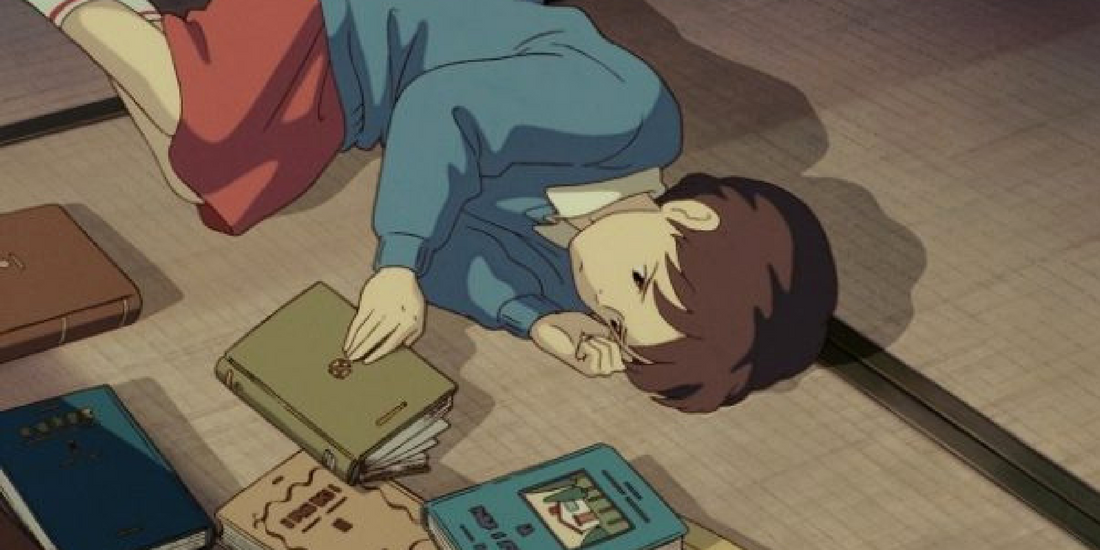
This is one of Miyazaki's finest works. He wrote the script, but the director is Yoshifumi Kondō – a rising star at Studio Ghibli who tragically died before he could make more films. It's a mostly realistic story about a bright high school girl who has to navigate a love triangle, the pressures of studying and her own budding abilities as a creative writer. The love triangle is almost a Shakespearian comedy, with lots of characters liking the wrong person or not realising who they really like. It culminates in a powerful scene in which Shizuku rejects a suitor, after which this plot strand is largely abandoned. Instead the film turns to explore the tension between artistic ambition and the daily demands of life, school and work.
Shizuku's relationship with her mysterious classmate (who hangs out with his antiquarian grandfather and wants to learn how to make violins in Italy) turns into an intellectual partnership as much as it is a young romance. Exposure to this new household filled with intriguing objects and where people have the opportunity to develop their creative talents is a spur for Shizuku to finish writing her own first story, to the point where she has to abandon studying for her exams. The effort is not cost-free – Shizuku's family become concerned about her behaviour and her grades. But in a heartwarming scene Shizuku's father intervenes on her behalf, giving her the support she needs to complete her personal project.
The film is conscious of the class dimensions to all this. Shizuku lives in a cramped apartment where she has to share a room with her older sister. Her lovesick best friend lives in a mansion by comparison, and her paramour Seiji also commutes from a fancier neighbourhood. Shizuku's mother is studying for an MA and her sister is saving money so she can move into her own apartment – both are focused on getting on in the world and find Shizuku's diversions from her schoolwork baffling. Her father is a librarian, and content with his job and position in life, which allows him to be more supportive of his daughter's artistic development. But it's clear that Shizuku doesn't have some of the advantages of her school friends, which stack the odds against her succeeding as a writer.
While the film is a melodrama, it's refreshingly grounded about these obstacles and burdens. The romance between Shizuku and Seiji is founded on an acknowledgement of their particular creative interests, and the understanding that they are to be nurtured despite the anguish of separation that might involve. It is a partnership in which each supports the other to fulfill themselves. The film's final scene, in which Shizuku and Seiji race up a hill to catch the sunrise, becomes a metaphor for their relationship, with Shizuku getting off Seiji's bike to push together towards their shared goal.
The film is conscious of the class dimensions to all this. Shizuku lives in a cramped apartment where she has to share a room with her older sister. Her lovesick best friend lives in a mansion by comparison, and her paramour Seiji also commutes from a fancier neighbourhood. Shizuku's mother is studying for an MA and her sister is saving money so she can move into her own apartment – both are focused on getting on in the world and find Shizuku's diversions from her schoolwork baffling. Her father is a librarian, and content with his job and position in life, which allows him to be more supportive of his daughter's artistic development. But it's clear that Shizuku doesn't have some of the advantages of her school friends, which stack the odds against her succeeding as a writer.
7.11.12
The Castle of Cagliostro
I remember Harold Bloom said somewhere that the object of Don Quixote's quest is ultimately unanswerable, that he endures his many humiliations because the reader demands it of him. I was reminded of this at the end of The Castle of Cagliostro (Hayao Miazaki's first film), when Clarisse asks Lupin to stay with her, and Lupin physically pulls himself away from the proposition. He can't settle down. Why? Unanswerable by the film itself, it's because the readers of the manga and the watchers of the anime series demand that Lupin stay the same adventurer-thief. Telling that such a finale does not feel like a cynical move to ensure the viability of further sequels, but rather suggests comparisons with Cervantes. Fact is, in that moment, I believed that Lupin is genuinely torn up at the prospect of love and serenity at the cost of abandoning his true self and forgoing a life of danger and excitement. Whatever essential qualities the character embodies (and I knew nothing about Lupin III before watching this film) Miazaki did a fine job of encapsulating them, and demonstrating just how essential they are.
15.7.12
From up on Poppy Hill
By some quirk of fate, I was actually in Yokohama when I watched this film. From up on Poppy Hill is set in the sixties, but Yamashita Park and the Marine Tower are still recognizable parts of the landscape. Like all Studio Ghibli productions, it is beautifully animated. Magical, even though it is one of the few Ghibli films which is set in a real place and time.
A bit like Arrietty, the story is slight, and unfolds at its own pace. It has some weak elements, however. The central mystery – are they or aren't they siblings? – is rather unbelievably melodramatic, as one of the characters admits. Perhaps baby-switching was a common phenomenon during and after the Korean war. Even if it was, I don't think the film dealt with the repercussions that creates particularly well. It is at its best when it explores the daily life, in school and at home, of the protagonist Umi. She is perfectly charming, and in her own quiet way, one of the most inspiring heroines the Ghibli production house has created. Which is saying something.
7.7.12
Arrietty
The urge to compare with other Miyazaki films still ever-present. This one reminds me most of Totoro, in its small scale and the way it slowly unfolds. It takes a certain amount of confidence to hold back so much in a film for children (espesh with the digital animation wonders Pixar is coming up with), and it is admirable, although (as ever) I prefer Miyazaki doing visuals and themes in widescreen. Should say he didn't direct Arrietty, he just wrote and produced it, tho I suspect creative control was quite close.
The pivotal scene is the conversation in which Arrietty reveals herself to Sho, where the subject turns to the way humans have changed the environment and have unwittingly destroyed countless species of animal and plant life. I'm not sure if Mary Norton's Borrowers were intended to be a comment on climate change, but this is what they become here, and it is an interesting imaginative conceit to take the POV of the creatures being trampled to extinction. They are tenacious and noble and so on. What's more interesting is the contrast between the unthinking, obsessive housekeeper Haru and the sickly, melancholic Sho – who is inspired by the struggle of the little guys and survives his operation (notably not a spoiler, since we are told this in the very first line of the film).
MOST interesting is the realisation that the Borrowers don't want our help, even though they are in a position of weakness. Arrietty and Sho's relationship can never develop, they are inalterably different and must live separately. My only problem with the film is is why it has to have an unhappy ending – why this inequality cannot be bridged, why humans cannot reach some accommodation with the natural world. Maybe Miyazaki isn't all that sanguine about the prospect, or maybe dramatically it would have been too trite a note to end the film on. But as someone who hopes to live on this planet for some time yet, and still manages to be impressed by the scale of human ingenuity, the tone felt a bit unnecessarily elegiac.
23.6.12
Porco Rosso
Better than Kiki, not as good as Laputa... (I've seen so many Miyazaki films now I'm getting the urge to rank them) This one is also built around Miyasaki's enthusiasm for flight. And also, maybe, Casablanca? With the jazz bar full of criminals and the protagonist full of inner demons. An enigmatic, cursed, noble but fallen hero, an anarchist giving his life to fight off fascists. A Byron, except of course it's not Byron, "It's mine! See you later!"
The most striking scene in the film is the bedtime story in which Porco describes his near death experience and transformation. Reversed when, as with the frog prince, he is kissed by a woman who loves him. The link between the two events is Gina, it seems. Her first husband was Porco's comrade, now dead. Perhaps Porco's swinish form is a symbol for survivor's guilt, which fades when he receives an unequivocal sign that Gina has moved on. There is a certain logic to that interpretation, tho it feels a bit pat, and I'm pretty sure Miyazaki had deeper things on his mind.
My guess would be that it's a gender thing again. Boys will be boys going off to fight stupid wars, marrying sweethearts and getting themselves killed. Porco survives all that disfigured, convinced of the end of innocence, the darkness of man's heart. And the women, Fio, Gina, are there to redeem the world. By showing that they are just as resourceful as men, and kinder too.
5.9.10
Howl's Moving Castle
This film has a lovely dream sequence that I think references the Cupid and Psyche story. Arguably, the idea behind the Ancient Greek tale is that lovers cannot resist prying into each others' inner psyches, but when they are fully revealed to one another, that love disappears. In the film, Howl follows Cupid in running away, but here it's because he is disgusted with himself -- his ugliness and also his cowardice. But love changes perceptions. It can make cowards into heroes, crones to maids. And I guess that is the point of the film.
But really, I'm clutching at straws. There is a LOT of stuff going on here, but little of it coalesced into something coherent by the end. The film as a whole had this feeling of drift. And it was resolved in this incredibly sudden, almost deus ex machina way. The motivation of the main villain remained inexplicable, and certain decisions by Howl also made little sense (why does he go and fight, when it causes his love so much distress?).
There are things the film gets right, of course. This is, after all, Miyazaki. The world-building is, as usual, astonishing. The setting has a kind of Prussian vibe, and the idiotic war being fought has the faint suggestion of the First World War, particularly conscription and arial bombing. Howl's creaking castle, on four mechanical chicken legs (reference to Baba Yaga?) and with its four-way door/portal, is a marvelous creation. You also get bee-like helicopter machines, shooting-star fairies, flying bat-wizards, the list goes on.
There are also brilliant storytelling flourishes. The way we are introduced to our protagonist Sophie, for example. How she reacts to her curse, both in the initial moments of realization, and in deciding what to do about it, is brought to life perfectly. It is such a shame that as the film goes on, the character slips from our grasp. While the film as a whole is erratically paced, certain segments build tension very effectively, using smash cuts to disorientate the viewer, or leave them hanging. There is also a repeated visual motif of stuff being obscured and revealed by mist or clouds (the film opens with such an image). A Cupid + Psyche metaphor, perhaps. Or the move from isolation to family, another theme that runs through the film.
So it's not an unenjoyable experience. But with an awareness of the kind of films Miyazaki is capable of making, it was a rather disappointing one for me. Too confusing, too aimless. It's a constellation of Miyazaki elements that doesn't unify into a whole that can be taken away, thought over and treasured. Not his best. In fact, it is the weakest one of his films I've seen.
20.4.10
My Neighbour Totoro
Kiki is more sophisticated, and Laputa more thrilling, but this wins because the relationship between the two siblings is JUST. SO. REAL. It's astounding. Miyazaki knows childhood back to front. He can capture it, distill it, and draw us a film that can take us back to when we were children. A master at work, ladies and gentlemen...
I don't know whether it's just me, but I got a whole heap of references out of the film. Most obviously, the line about the trees no longer being our friends recalls the Ents in The Two Towers. More broadly, the set-up is straight out of The Lion, The Witch and the Wardrobe. Indeed, at the Stone Table Susan and Lucy deal with berevement before having their hope restored. Satsuki and Mei go on the same journey. Finally, what is Totoro if not a bear-shaped Mary Poppins, complete with umbrella? Like the flying nanny, he shows the kids in his care what a magical world they live in. So you have environmentalism, growing up, and child-like wonder all rolled into one. A great way to spend 80 minutes.
31.3.10
Kiki's Delivery Service
The weakest Miyazaki film I've seen so far. Still incredible, sure -- this guy doesn't make bad films. But I found Kirsten Dunst rather hysterical. And the cat is no Salem from Sabrina the Teenage Witch. Moreover, the first half of the film meanders a bit too much. And while the world is meticulously constructed, it doesn't compare with what Myazaki has created elsewhere.
Would it be too outrageous to say this is Myazaki's film about capitalism? Guffaw if you like, but when Kiki realizes that earning a living doing what you love makes it harder to love it... that encapsulates the frustration of having to balance fulfillment with selling yourself to live. Miyazaki's heroines are always uncomfortable with barter. Living in the big city, Kiki is forced into it. The pressure of her work saps her magical ability, and she has to go chill out -- find that inspiration again. A holiday in the woods and a pep-talk from an artist helps, but what really does the trick is saving Tombo -- letting someone else in. Independence is hard. Sharing the load, especially with someone who shares your passion, makes life in the big city easier. Just look at the wife and husband team that run the bakery.
Is Miyazaki suggesting that girls in big cities need husbands in order to survive? Maybe. The fact that he doesn't patronize saves his skin. Still, I wouldn't mind seeing Myazaki present some boy-heroes that are as selfless, and as vulnerable, as Kiki.
18.2.10
Ponyo
Magical, as you would expect. It's almost funny how comprehensively Miyazaki annihilates every other animated film ever made. The man is a wizard. A bona fide miracle-worker.
Ponyo is about growing up -- a little girl who is smothered by her father, who does not care about the duties he must perform, who runs away to explore the world. All fine, but I'm a little uneasy about the ending. There is a 'marriage', where the 'husband' is tested to see if his devotion is genuine. If he is ready to be responsible, then Ponyo will lose her magical nature (read: 'innocence') and join the real world. If he isn't, and gives Ponyo back to her father, she will die and the world will end. I'm slightly uncomfortable with how little agency Ponyo has in this process. She is in a bucket passed from her father to her 'husband'. But maybe I am mental and read into things a bit too much.
The kiddy stuff is wonderful, but what is really special about the film is Lisa. A fully realised adult character in a children's film -- when do you ever see that? Perhaps the most affecting moment (of many) is when Sōsuke comforts his pissed-off mother after she learns that her husband has shipped out again without returning home. There is a tension in this adult marriage. The 'responsible husband' and 'caring wife' ideal set out between Sōsuke and Ponyo isn't without its problems once it becomes a living reality. You get distance. Husbands (and fathers) are too busy being responsible to look after their family. Perhaps Miyazaki has used this adult relationship to critique the idealism of the kiddy relationship? Am I just being mental?
Subscribe to:
Posts (Atom)


