22.5.20

Election

What is the motivation behind Jim McAllister's resentment of Tracy Flick? Surely a civics teacher would be delighted that one of his students takes such an interest in his subject, and is so driven to succeed. The answer isn't as simple as it might appear. Jim's own explanation is that Flick ruthlessness needs to be countered otherwise her life will be spent crushing the voices of the people around her, although that's based on a partial and unfair view of Flick's affair with his friend and colleague – which destroyed his career and marriage. The irony (in a film full of ironies) is that McAllister's intervention against Flick destroys his own career as well (his marriage he manages to destroy himself).


So there's something else going on as well – the resentment of a mentor who can see that his charge will go on to far greater success than he managed. He's just a civics teacher, but Flick will end up being a politician for real. McAllister might try to comfort himself with the notion that his life is ultimately more rewarding, even after he's lost his job and has to move to New York, but that's just cover for the envy he must feel.

And there is definitely a gendered quality to this antagonism as well, which the film brings out in its darkest moments. McAllister doesn't actually understand women – not his wife, nor the woman he tries to have an affair with. His best friend has related his sexual experiences with Flick, and she becomes sexualised by him as a result – drawn out by the fact that his first move against her is inspired by a porno film, and her face keeps popping into his mind when he's having sex. McAllister's irritation may be that he's not used to "uppity women" telling him what to do, and working with Student Council President Flick for a year presents a sufficient challenge to his authority for him to want to avoid it. But the film suggests that these feelings are curdled by a deeper annoyance that this powerful woman is not sexually available to him.


Although Election is supposed to reflect and satirise in microcosm the American political system, the parallels only go so far. The fundamental tension of politics between the rule of the specialised few and the rule of the many, and the way our system of representative government comes to an uneasy accommodation between the two, is only hinted at in McAllister's lecture about the importance of political choice. Tammy's kamikaze run at the presidency may be a nod to the attractions and dangers of political populism – she is right that in some sense the system prevents genuine change, but her (wildly popular) solution to dissolve the meagre democratic elements of that system would just make the problem worse. These are asides in a film ultimately more interested in dissecting the ways men can have mid-life crises, and drawing out the grim comedy inherent in such situations. It's a subject that becomes a through-line in Alexander Payne's work, and unfortunately it's not one I'm particularly interested in.

The film makes liberal use of voiceover to highlight the characters' feelings, and also their inability to fully understand themselves. It's probably just personal preference, but I do find that the way the technique is deployed tends to trivialise its subjects, reducing them to caricatures. The depths in the film are revealed through the characters' actions and interactions, and gaining access to their thoughts paradoxically puts us at a distance from them. We are given the opportunity to rise above the events we are watching, and feel a smug satisfaction in observing these strange, unsatisfied people and what they get up to. The more confrontational approach would be to eliminate such avenues of escape, so we are truly in the moment when McAllister or Flick lose their minds.

14.5.20

Planescape: Torment

This is a very strange game, in that so much of the stuff that's memorable and even moving about it is pretty much extraeneous to its mechanics. You can 'play' Torment badly as a typical CRPG where you kill things for cash and experience, but you would miss maybe 90% of the content, which is in the reams and reams of text you read. Even then, the 'conversation battles' that you have (which tend to be a more effective way to gain XP and levels anyway) are not actually the highlights for me. Instead it's the descriptions of certain key memories you unlock, all of which are optional extras there to fill out the story.

In another game these memories would be conveyed visually through cutscenes. In Torment you read about them as you would a novel – your dialogue options stripped away to just continuing or stopping. They are chunky intrusions into the gaming experience, and normally when a visual medium does this it is an irritant (particuarly noticable and egregious in comics). But here it becomes a test case for the power of the written word in evoking character and emotion. 


Three memories in particular stand out for me. They are all examples of a previous incarnation of you (the 'practical' one – although that's quite a polite way of decribing what is actually a highly-functioning sociopath) tormenting other NPCs in the game. The justly-acclaimed sensory stone 'experience' with Deionarra is the most ambitious, in that it's told from three angles simultaneously – with the account diving into Deionarra own feelings of heartfelt devotion, then switching to your previous incarnation's heartless manipulation of her, and adding your present day reaction to the unfolding events, which heightens the sense of stakes in what to a completely external observer would be a rather unremarkable exchange between two potential lovers. The dramatic tension is created by the contrast between what is in these characters' heads, and the knowledge that Deionarra's small-scale decision to accompany this man has proved fatal.

The other two memories both involve this previous incarnation physically abusing two NPCs that you can recruit into your party – Ignus and Morte. In a game where you can slaughter scores of low-level criminals without much thought beyond how irksome it is that they keep attacking you, it is another testament to how words can bring out the reality of violence so much more powerfully than visuals. It is in the specific descriptions of flesh burning and bones cracking, the sounds and smells that are evoked, which underscore how cruel your previous incarnation was, and how much you have to atone for his crimes.


This would be really great writing anywhere, but in the context of what is ultimately another Dungeons & Dragons CRPG made in the Infinity Engine it is particularly novel and striking. Sometimes you do need a lot of words to bring out the detail of the interactions between characters, and perhaps it's not possible to get to the depth of characterisation Torment achieves without that wordcount.

So maybe it's fair that detractors of the game suggest that it would really work better as a novel. There is no player choice in those three memories. It's just flavour of a particularly bitter kind – underlining just how much of a shit you used to be. Actually, the Enhanced Edition comes with a novelisation when you buy it on GOG, but it's telling that I haven't really been tempted to read it. Although player choice isn't a feature of the game's emotional highpoints, it is still a significant part of the conversations and decisions you make when playing, to the point where having a single definitive version of events doesn't feel like it will capture the richness of the game itself.

If the above sounds like I'm downgrading the importance of visuals in telling Torment's story, I don't actually think that's the case. It's just that Torment employs them in the right way – realising the fantastic world that provides the backround to these small but poignant character moments. This is actually a better-looking game than its Infinity Engine precursor Baldur's Gate, but in both games the visualisations of the characters isn't the main draw. Instead, much of the beauty lies in their richly rendered maps and the well-designed soundtrack, which even in Baldur's Gate is full of incidental details that deepen immersion in the world. And while Baldur's Gate is purposefully traditional in scope – aiming to faithfully translate the Tolkienesque Forgotten Realms D&D setting into a computer game, Torment reflects the oddball sensibilities of its Planescape setting, where literally anything is possible if you believe in it hard enough. Sigil is a feast of spiky buildings and spikier inhabitants. The visuals are there to do something that the words will have a hard time doing – which is to easily evoke an environment and atmosphere that is literally otherworldly. Contrast that to the next iteration of CRPGs like Neverwinter Nights and Knights of the Old Republic, which went 3D and put lackluster character animation to the fore, and it's hard not to conclude that the isometric display of the Infinity Engine was the right way to go.


A note on the combat, which gets a bad rap everywhere. Maybe the Enhanced Edition has tweaked the game to make it more balanced, but I generally didn't have a problem with it. By the time I got to the first big dungeon I had two fighters in my party to protect my squishy mage, and they were robust enough for me to face down Many-As-One, which in one of the many inversions of the game makes rats (normally a weak tutorial enemy) into a tough and scary boss fight. The only actively irritating part of the game was the Modron Maze, which is a dungeon designed by computers and is almost purposfully unenjoyable, and I had no qualms about cheating to get myself through it. By the time I got to Curst Prison I was geared up and had unlocked stat boosts for my main fighters, and could use my thief to scout and backstab. So for me it was actually pretty fun to pull enemies out with Morte's taunt ability and chop them up one by one, or mess them up from afar with AOE debuffs. Torment lacks the four-dimensional chess aspect of the magic system in Baldur's Gate II, where preparation, combos and counters can make you feel exceedingly clever in finding the right solution to get through an encounter. But there is still a certain kind of satisfaction in having your specced up party be capable of taking down hordes of beasties in UnderSigil, a totally optional combat dungeon at the end of the game.

Torment scales back the variety of spells, weapons and monsters found in Baldur's Gate. Instead its development resources were spent on its wordcount, which meant delving deeper into a smaller number of companion characters, and fashioning a more intricate and satisfying story. The conceit of the game – an immortal who has lost his memory and must find out who he is – is shaped into a metaphor about facing up to the mistakes you made in the past, and accepting responsibility for them even if they were in some respects committed by a different person. The game keeps circling back to the question of "what can change the nature of a man", but the answer is ultimately individual and not especially relevant. Instead it's the premise of the question that's important – your nature can change. And while that sounds hopeful it does not liberate you from having to deal with the consequences of the actions of your past selves. And for me it's the excellently written memories in the game, which detail the specific personal torments you have inflicted, that really hits that message home.

10.5.20

Chloe

The necessities of the thriller genre demand that Chloe remains a mystery, even after the film ends. It's unfortunate, because like a lot of thrillers the plot hangs together by threads and really the central conceit is ridiculous when you take a step back and think about it. Julianne Moore starts to suspect that her husband Liam Neeson is having an affair, and (very randomly) finds a sex worker played by Amanda Seyfried to try and seduce him in order to prove to herself that he is a serial philanderer. But Chloe turns out to be very capable at seduction, and is ultimately more interested in Julianne Moore than anyone could have guessed.


But why? Egoyan's Exotica proved that the filmmaker has an interest in the strange things broken people do in order to put themselves back together again. And it feels like Chloe is one of these people. We only get inside her head at the beginning of the film, through voiceover, where we're told of her awesome powers of knowing exactly what people want, and giving it to them. What's left is a hole which Chloe seeks to fill by ingratiating herself into the lives of a fabulously successful middle-class family, and tearing them apart.

We know nothing about Chloe's background, but sex work isn't often very glamourous even if you're at the upper end of the market, and I wonder whether her machinations aren't partly motivated by resentment. The film luxuriates in the accumulated capital of the unsuspecting family – they have an ostentatiously-designed house, beautiful furniture, and they spend all of their time in fancy restaurants. This is a film about well-off people having marital problems (the dullest genre of contemporary fiction), but then the added ingredient is someone on the very margins of society looking in and seeing what she doesn't have.


Maybe class envy is a reach too far, although it does make the film's glossy sophistication a tad more bearable. There is instead a throwaway reference Chloe makes to her mother's hairpin, which the film makes symbolically significant. Chloe lied about the hairpin previously, but perhaps the connection with her mother is true, in which case her wish to give it to Julianne Moore may be inspired by a need for a replacement mother, or a route into a family she doesn't have.

The last shot of the film shows that Moore has accepted that gift, even when Chloe is no longer there. Chloe has been turned into a thing, which just highlights that for much of the film that's all she was. But at least that thing now finally starts to have a meaning for Moore. Chloe is no longer just a tool or a vessel for other people's desires, but someone with desires of her own. In the erotic thriller genre, the femme fatale's motives are usually malevolent, but here it's Chloe that's ultimately the most out-of-control and desperate, even if Julianne Moore is the one that looks like her life is falling apart. Accepting the gift is an act of forgiveness, and perhaps also a recognition of Chloe's subjectivity, even if it remains largely elusive to her, and us.

3.5.20

Portrait of a Lady on Fire

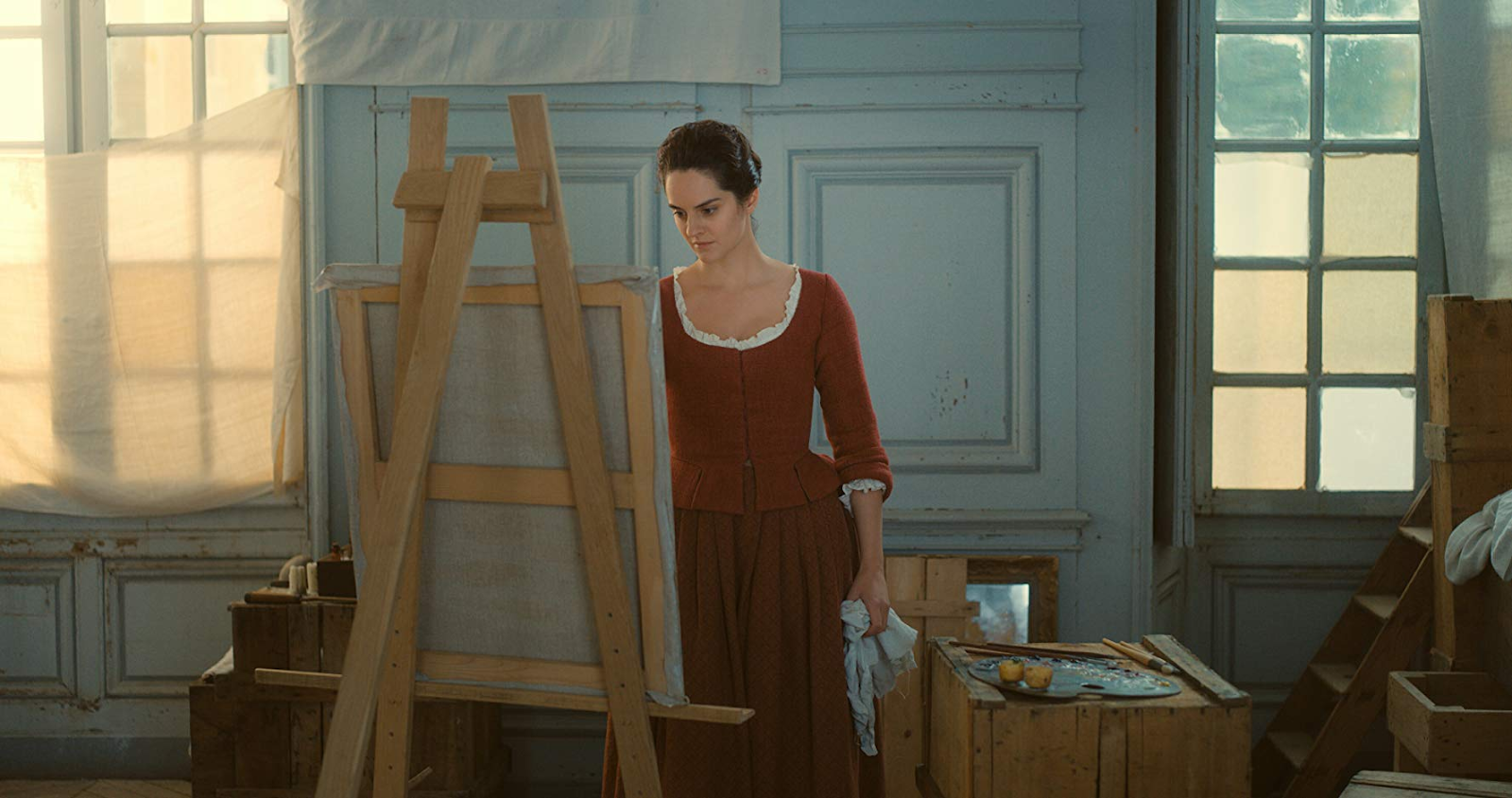
From the opening credits a parallel is being set up between the film we are watching and the act of painting. It is about the process of composition as much as it is about the process of falling in love. In the first scene, one of Marianne's students unearths a painting of hers which shares the title of the film. It's a work of art displayed against the artist's will by a proxy for us, the audience. The film is the painting. It's an example of the art that has been buried for expressing something hidden and forbidden, produced without the sanction of the arbiters of moral and aesthetic tastes.


The story starts off like a low-key thriller. Paintings in this society serve as adverts in the patriarchal marriage market, but the male painter couldn’t finish Héloïse's portrait as she refused to sit for him. Héloïse is determined not to be complicit in the creation of art that she has no control over in the same way as she is resisting her mother's attempts to place her in a marriage she has no say over. So her mother asks Marianne to pretend to be a companion, observe her and paint her portrait in secret. The portrait we see at the beginning of the film, which is allegorical rather than representative, cannot serve that purpose. So we know already that this relationship has been the foundation for a more genuine form of art as well as a more genuine kind of romance.

In the various paintings Marianne makes of Héloïse, we see that the latter is teaching the former to abandon the conventions and constraints of the time to arrive at a truer form of self-expression. Love and artistic breakthrough are intertwined. In the final painting in the film we see that Héloïse has managed to assert some control over its creation as well, smuggling in an erotically-charged message to Marianne in what is otherwise a celebration of family values. There is a secret history of art created by women excluded from the canon by their gender, and this film is a celebration of, as well as a participant in, that history.


Sciamma is constantly prodding at the inequities of the past. Héloïse's sister committed suicide, perhaps to avoid her fate of being married off to a man she doesn't know, but that means Héloïse must take her place. Marianne questions the freedom Héloïse found in the convent, but it had a library and music, and she felt she was treated as an equal. Men are almost literally peripheral to the film, appearing taciturn and stony-faced to transport Marianne to the island at the beginning (in a scene heavily redolent of The Piano) and take her away again at the end. There are no men at the fete, and the servant relies solely on the company of women to get an abortion. The father isn't mentioned but is probably the previous painter – a failure as well as a source of obstacles and problems. Héloïse's mother is complicit in the patriarchal system (for understandable reasons – there are always trade-offs in life). She must also be removed for the romance to blossom. The radical implication is that only in supportive women-only spaces are women allowed to love and create freely. A throwaway scene in which Héloïse chops up some giant phallic-looking mushrooms for the stewpot might be the film's final word on this.

25.4.20

Whisper of the Heart (If You Listen Closely)

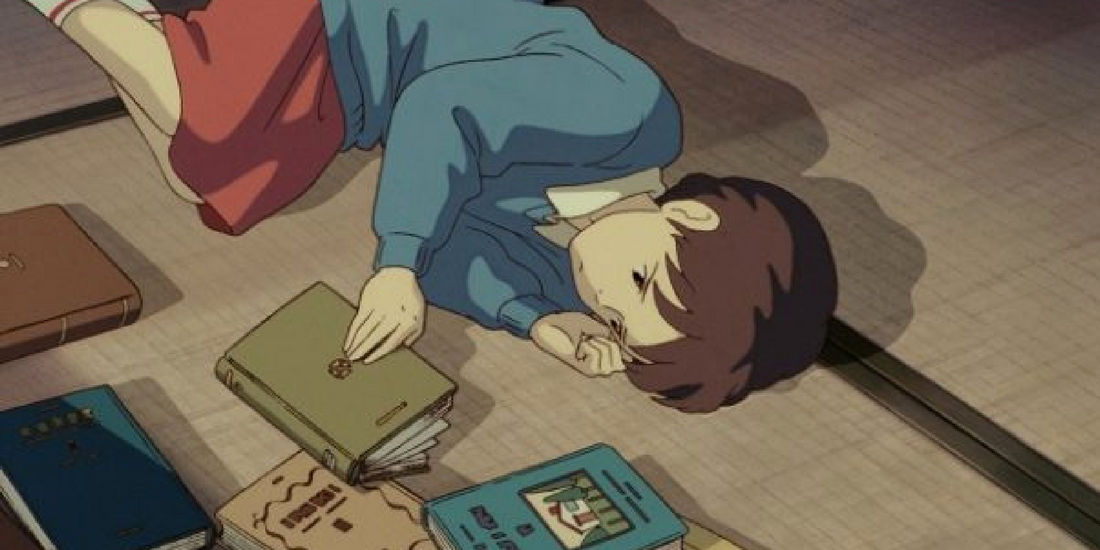
This is one of Miyazaki's finest works. He wrote the script, but the director is Yoshifumi Kondō – a rising star at Studio Ghibli who tragically died before he could make more films. It's a mostly realistic story about a bright high school girl who has to navigate a love triangle, the pressures of studying and her own budding abilities as a creative writer. The love triangle is almost a Shakespearian comedy, with lots of characters liking the wrong person or not realising who they really like. It culminates in a powerful scene in which Shizuku rejects a suitor, after which this plot strand is largely abandoned. Instead the film turns to explore the tension between artistic ambition and the daily demands of life, school and work.


Shizuku's relationship with her mysterious classmate (who hangs out with his antiquarian grandfather and wants to learn how to make violins in Italy) turns into an intellectual partnership as much as it is a young romance. Exposure to this new household filled with intriguing objects and where people have the opportunity to develop their creative talents is a spur for Shizuku to finish writing her own first story, to the point where she has to abandon studying for her exams. The effort is not cost-free – Shizuku's family become concerned about her behaviour and her grades. But in a heartwarming scene Shizuku's father intervenes on her behalf, giving her the support she needs to complete her personal project.


The film is conscious of the class dimensions to all this. Shizuku lives in a cramped apartment where she has to share a room with her older sister. Her lovesick best friend lives in a mansion by comparison, and her paramour Seiji also commutes from a fancier neighbourhood. Shizuku's mother is studying for an MA and her sister is saving money so she can move into her own apartment – both are focused on getting on in the world and find Shizuku's diversions from her schoolwork baffling. Her father is a librarian, and content with his job and position in life, which allows him to be more supportive of his daughter's artistic development. But it's clear that Shizuku doesn't have some of the advantages of her school friends, which stack the odds against her succeeding as a writer.


While the film is a melodrama, it's refreshingly grounded about these obstacles and burdens. The romance between Shizuku and Seiji is founded on an acknowledgement of their particular creative interests, and the understanding that they are to be nurtured despite the anguish of separation that might involve. It is a partnership in which each supports the other to fulfill themselves. The film's final scene, in which Shizuku and Seiji race up a hill to catch the sunrise, becomes a metaphor for their relationship, with Shizuku getting off Seiji's bike to push together towards their shared goal.

15.4.20

Ferris Bueller's Day Off

If you are lucky enough not to have to play by the rules, why should you? This film is a diatribe against the politics of envy – if you feel resentment at other people’s good fortune then the problem is your own. Those that become obsessed by it (like the hapless Ed Rooney) end up ruined, whereas Bueller’s sister manages to let go, and bag herself a smooch with Charlie Sheen in the process.

Bueller is wired for success despite his slacker attitude. Preternaturally self-confident, a wizard with technology, and from a comfortably middle-class background, he’ll no doubt end up making and losing millions in the 90s dot com bubble. The film notes the inadequacies of high school education (a mixture of dull rote-learning and horrific army-style exercise) and suggests that the ingenuity and creativity inherent in spinning your way through a day off is a better use of your time. Bueller’s father works in advertising and it looks like Bueller’s talent for bullshitting is inherited. A large detached house in the suburbs and a brood of incorrigible kids beckons.


Matthew Broderick does his best to make this shyster as lovable as possible. Perhaps having some experience of that European socialism Bueller dismisses so breezily I am somewhat immune to his charms, and find the film’s celebration of individualistic free-riding a bit distasteful. Part of the fantasy of this film is that its YOLO attitude never has negative consequences, when in fact civilisation is built on the ability to adhere to rules even if they don’t benefit you and to sacrifice today’s pleasures for future rewards. Bueller’s day off is a holiday from the world. It’s a break to enjoy the sights before the speed of life takes over again.

It’s telling that Hughes’s attempts to imbue the character with some sort of fellow-feeling ring false. Bueller volunteering to take the rap for his friend trashing his father’s car is supposed to be a heartfelt moment, but could just as well be a double bluff playing on Cameron’s emotional instability. You can’t escape the suspicion that everyone is a mark to him.


Hughes touches on some quite dark themes of depression and suicide with Cameron’s character, but you never get the sense that Bueller actually cares about him. His diagnosis that Cameron just needs more sexual experience in order to be able to assert himself is both sexist and wide off the mark. There's also a deeply weird moment where Cameron leering at Bueller’s girlfriend is framed as some sort of moment of personal growth. Cameron feels like a character from another film – someone with demons to exorcise who unfortunately has only Bueller and Hughes to help him.

It's a self-indulgent film, with expensive helicopter shots, an arty montage sequence in a gallery, and an over-the-top parade scene that feels like the film has momentarily turned into a musical. Although it is still a collection of parts, the focus on a single character who directly lectures his audience makes for a less disjointed film than something like The Breakfast Club. Ed Rooney is a cartoon villain, and his attempts to catch Bueller prefigures Hughes's script for Home Alone. The fact that such childishness sits alongside scenes in which Cameron and Sloane walk around Chicago admitting their existential terror at the prospect of the future makes this a weird hybrid – both a kids comedy and a teen drama. Much like Bueller's outrageous schemes, it just about manages to hang together.

16.3.20

Night of the Comet

A foundational influence on Buffy the Vampire Slayer, so obviously I watched it when it came up on Netflix. It's a 1980s horror-comedy which isn't particularly scary and where the comedy is partly about the film's own knowingness about the genres it's operating in. So you can see why Joss Whedon might have been into it. The film starts off in a cinema and has several key scenes in a radio studio, and both the movie posters that decorate the sets and the brash pop music soundtrack (mostly diegetic) provide a metacommentary on the unfolding plot. That distancing effect crosses into the dialogue. There is some (unconvincing) acknowledgement of the trauma of having the world end, but for the most part the survivors react to the situation with a healthy amount of ironic detachment.


Eberhardt's inspiration for the script came from joking around with teenage girls about what they would do in a zombie apocalypse, and reflecting the fact that his respondents were mostly worried about not being able to date anymore. The sense of possibility inherent in a largely automated world where the adults have disappeared is at the heart of the film and is highlighted by its ending, where the guns are put away and a new and happier family unit is established amidst the ruins of the city. The apocalypse purifies the world of absent fathers and abusive mothers, and allows for the creation of something new. You can see the impact on Whedon when he describes most of his projects as being about the formation of alternate families.


Part of the film's purpose is to demonstrate that typical California girls are tougher and more resourceful than the horror movie stereotypes would have you expect. They can be sexually active, obsessed with arcade games or on the cheerleading squad and still fight off zombies. The big twist in the film is also gendered, in that the government agent you expect to be evil but who ends up saving the kids is a woman overruled by her male superiors. The film has a refreshingly uncondescending approach to its hard-bitten female characters. It's yet another thing Whedon will have picked up on when creating Buffy.

7.3.20

Fleabag

I've been trying to work out why this doesn’t irritate me the way Lena Dunham’s Girls did, given the initial similarities. For all of Dunham's self-flagellation, there was nonetheless a sense of entitlement to her project – ultimately she does want to be the "voice of a generation" despite the claim being sheathed in irony within the show. Her erasure of people of colour is all the more damning as a result. Fleabag is also white and middle class (and to my eyes the design of her flat doesn't quite square with the economics of running a failing small business in London), but she has no pretensions to being destined for great things. She's just another lost soul in the city.


The stakes are also higher than anything Hannah Horvath has to deal with. Both characters have a lack of self-esteem which lead them to make poor romantic choices (to put it mildly). But with Fleabag, this is presented as a kind of yawning crater opened up as a result of multiple bereavements, made worse by the fact she blames herself for one of them. The show is funny in the typical excruciating British comedy-of-manners way, but it's just as much a dark drama about someone's life falling apart, and their attempt to clutch desperately at things that might put it back together.

That's the first season anyway. The second one is about the upswing after reaching the pits of despair. The cleverest part of the show is that it finds a way to provide a psychological explanation for its signature technical innovation – Phoebe Waller-Bridge's masterful asides to camera. I imagine this technique grew out of the show's origins as a one-woman play, but there was always something slightly incongruous about a deeply lonely person having this animated inner dialogue with the audience. Who really is she talking to?

The introduction of a love interest who is a priest brings this out. The dramatic tension inherent in a sexually voracious character falling in love with someone sworn to abstinence is obvious. But the connection the two characters form is built on this propensity to communicate with invisible people. The show draws this out explicitly – the priest is the only one who can sense Fleabag's asides, even if he can't overhear them. They are prayers, and we are Fleabag's chorus of gods.


The arc of the show thus becomes Fleabag's conjuration of an army of silent companions that bear witness to her struggles – an imaginary source of comfort and validation she cannot get from her deeply messed up family. The show ends with the realisation that she doesn't need us anymore –  unlike the priest, who chooses God over love and in doing so is revealed to be a coward. The show might break off the affair at the end, and be seen to end on a downer. But there is a triumph in Fleabag's final wave goodbye to us. She is casting off her crutches and is finally able to cope on her own.

19.2.20

Only Yesterday (Memories Come Tumbling Down)

A carefully-wrought, subtle drama from Studio Ghibli's other great maestro Isao Takahata. It reminded me a bit of George Eliot's The Mill on the Floss, in that the depiction of the protagonist's childhood puts her adult character in perspective, although the connections are elliptical and sometimes mysterious. Nevertheless a picture emerges of a spirited young girl who is overlooked, insulted and on one occasion straight-up abused by her family – not out of spite or ill-will, but because her parents are tired and confused and don't have the emotional resources to support their youngest child. The result is an outwardly successful young woman with a job in Tokyo who feels like a ghost.


The solution to Taeko's alienation is a holiday to the countryside, where she joins the villagers in their back-breaking agricultural work. The family relationships she discovers there go some way towards mending the traumas buried in her past. The contrast between town and country is a well-worn trope, but the most impressive thing about the film is that it always endeavours to strike a balance between idealism and realism. An example is the organic farmer lecturing on the importance of respecting nature, but also admitting to using weedkiller because there just isn’t enough agricultural labour in modern times to pull the weeds out by hand.


Another example comes at the end when the possibility is raised of Taeko giving up life in the city and finding romance in the countryside. She treats this as a ridiculous suggestion and describes it as something out of a film. The irony, of course, is that this is a film, and in the final moments she does turn back. But this surrender is presented as a fantasy – it's part of the credits sequence where the music swells and the ghosts of the past appear to guide Taeko to happiness. It's where the film abandons verisimilitude and turns overtly film-like, and the balance tips into unadulterated romanticism. It feels like something that happens after the story has ended and Taeko goes back to Tokyo. I suspect Takahata wanted to give his audience a reward for persevering with the difficult work of a woman coming to terms with her past. But that reward is offered grudgingly, presented as a flight of fancy – almost an afterthought. As Taeko says, it's something that happens in films but is impossible in real life.