Showing posts with label Makoto Shinkai. Show all posts

19.8.18

A Silent Voice (The Shape of Voice)

A two-hour teen drama anime that's on Netflix at the moment. My wife wanted to watch something romantic in the spirit of Your Name (which we both love). Indeed, Makoto Shinkai thoroughly recommended A Silent Voice when it came out, but actually it is both a darker and more flawed piece of work. First the darkness – the anime begins with a suicide attempt by a teenage boy, before we flashback to his primary school years where he horrifically bullies a new deaf student. The initial flood of sympathy for the character curdles as we see him shout at her, throw dirt in her face and rip out her hearing aids. The incidental details lend credibility to the depiction: the teacher is young, bored and ineffective; the are no father-figures anywhere to be seen. It's a useful corrective to to the idea that Japanese children are somehow always well-behaved, dutiful and hard-working.


The anime is about how as a teenager Shōya starts to atone for the mistakes he made as a boy, and learns how to build real friendships. Some of this is handled expertly. The pressure of social opprobrium is what leads to his feelings of worthlessness – suicide for several characters is seen as a way to remove a burden on others. If they can't get anything right, they might as well cease to exist.

The anime missteps when it dilutes its sense of realism by indulging in unnecessary theatrics. It starts out as a drama and increasingly slips into melodrama. At its most fanciful the anime contrives a serendipitous midnight meeting which is arranged almost telepathically. When the manipulation of an audience's feelings is this discernable, it loses its force. And there are several moments towards the end which stumble as a result. That's a shame, because with a few tweaks A Silent Voice could have hit just as hard as Shinkai's superhit.

28.2.18

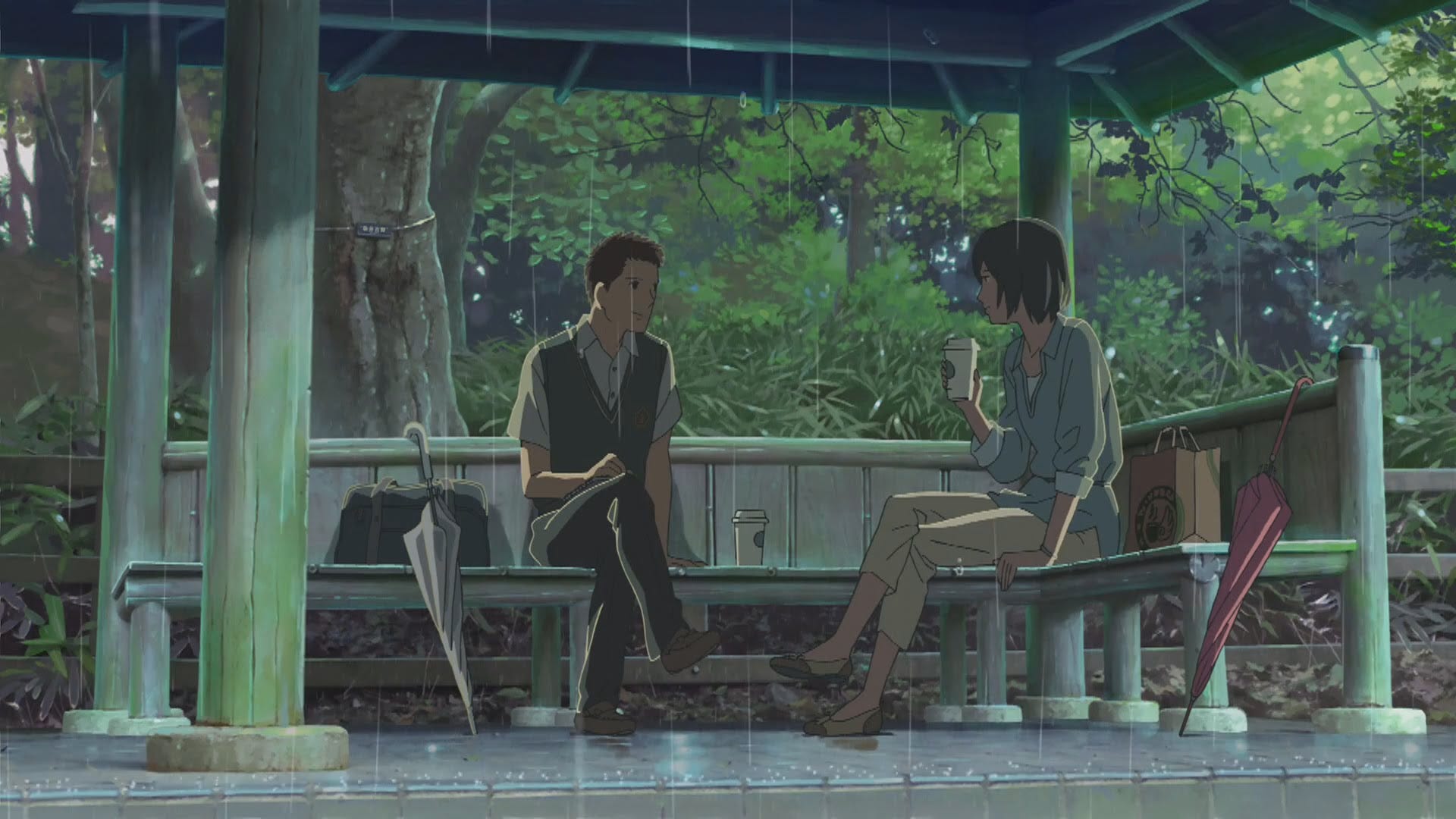
The Garden of Words

The feature Makoto Shikai made before the phenomenally successful Your Name has come on Netflix. It’s 45 mins long, and the irony of a precocious teenager teaching some life lessons to an older woman is evident even before the big reveal halfway through: that the woman is in fact a teacher at the boy’s school. A second irony is added when the teacher is hounded out of her job by false allegations of seducing a student. The repercussions of that accusation is what puts her in danger of seducing a student for real.


These ironies don’t lead anywhere, and perhaps they don’t have to. Watching this after Your Name, it’s evident that Shinkai has an interest in star-crossed lovers brought together and torn apart by fate, a force given an almost physical presence by the photorealistic hyperreal animation. It’s manipulative – a reliance on these tricks is why I dislike Wong Kai-Wai so much. For some reason, Shinaki’s equivalent is more tolerable, perhaps because we get under the skin of his characters to a greater extent than the detached cool of Wong’s lost urbanites.

Like Your Name, The Garden of Words ends on two characters on a set of stairs finally recognising each other. It’s a climax that Wong refuses to grant his viewers, and his films end up feeling emptier as a result. This, on the other hand, is generous, well-paced, and satisfying, despite the open-ended finale.

2.12.16

Your Name

I've previously been a bit harsh on Matoko Shinkai. Your Name doesn't abandon the romantic longing of 5 Centimeters Per Second, but the angst is worn more lightly, and the characters feel less like ciphers. The animation is also more restrained – the night skies no longer look like Rainbow Road in Mario Kart, and there is a rather cool dream sequence which swaps crisp photorealism for a more flowing, sketched style.


The plot, as with many a time travel story, breaks apart the more you prod at it. But the conceit of two teenagers switching bodies is employed well. Shinkai has said that some of the town vs country stuff comes from his own experience of growing up. More important for me, however, is the way inhabiting another person's life becomes a metaphor for falling in love. Because being in a relationship is sort of like that. You gain access to memories of things you didn't experience at first hand. You learn about a childhood different from your own, with a new family and set of friends. You also get to know someone else's body in intimate detail (a source of some of the film's funniest moments). And by becoming comfortable in each other's skins, the two characters find that they cannot live happily without each other.

This is eked out a bit in the final part of the film, where Shinkai contrives to separate his heroes, and have them morosely wander around Tokyo searching for their other halves. But it serves to highlight how draining the loss of such a person might be, and it leads to a very satisfying finale.

10.9.16

5 Centimeters Per Second

"...if you look at our everyday lives, you realise that we're well-fed, well-clothed and well-housed. We also live in a society where there's almost no class discrimination. And we have freedom to live our lives however we want. Considering what kind of society we live in, if you still have problems with relationships with people, the cause of the problem is probably not society or anything readily apparent. In that case, you have to find the cause within yourself. That's actually a hard thing to do, I think. You might think there's a nothing within you that's causing the problem. So I had a strong desire to portray that 'nothingness' as it is."

That's the director Makoto Shinkai on the film. No doubt he's somewhat blinkered in his view that society places almost no restrictions on our liberty. That kind of complacency is frustrating, but the myopia runs deeper. The truth is, trying to isolate the cause of your discontent without reference to the expectations placed on you by others is a mug's game. That's why the characters in this film feel more like archetypes role-playing doomed love affairs rather than real people. Takaki is little more than a dreamy heartthrob yearning to protect Akari from the evils of the world. Their drifting apart is the product of the cold mathematics of speed and distance – their families move away, it's too far for them to continue their relationship. It's as simple and as brutal as that.

The real highlight is Kanae in the second 'Act' of the film – the only time it adopts a female perspective. She also pines after the cool Takaki, and formulates her life-projects with reference to his own. That leaves her in limbo when she realises that he will never be interested in her. In fact, her one moment of glory comes when she achieves something on her own – learning how to surf from her older sister. That victory is clouded by her subsequent rejection, but it points to the damage caused when tying up all your self-worth onto the whims of another person.

There is another highlight, of course – the dazzling imagery. Every frame of the anime is polished to a brilliant sheen, sometimes to the point of distraction, particularly when it comes to the nebula-stuffed starry skies. The animation is more impressive when it comes to the everyday details of train stations, convenience stores and countryside roads, which capture the look and feel of Japan unbelievably well. It's those wonderfully realised bits of quotidian existence that add a weight to the otherwise fluffy angst the film is portraying. It's a shame that for all his efforts to embed them in the real world, Shinkai can't make his characters actually feel real.