My problem with The Avengers is that Thor was too good. Specifically, Tom Hiddleston in Thor, whose performance I think matches the range and intensity of Heath Ledger's Joker. As Film Crit Hulk (my own film crit hero) points out, in The Avengers Loki serves to accentuate and develop the arcs of the six main characters. But this leaves less room to explore his own background and motivations.
Let's look at those anyway. From Thor, Hiddleston brings a feeling of resentment and ambition, but he also takes on something of the Red Skull's ideology in Captain America. Humans have weak minds imprisoned in frail bodies, and require a Nietzschean strong man to rule them. Happiness for most lies in the predictability of slavery — the alienation of the responsibility associated with free will.
And the way humanity decides to fight this evil is... to get a bunch of strong men to defend or avenge them. There is a tension here, which was brought out for me in a scene between Captain America and two cops, where the latter claim the responsibility of defending the innocent, before willingly divesting themselves of that responsibility as soon as Cap demonstrates his superior strength. This moment is played for laughs, and sure Cap's authority comes from charisma rather than fear — the fact that the Avengers use their power to defend freedom makes them the heroes. And the totemic idea of Phil as the rallying force behind the team gives an 'of the people' spin on their activities. I'm aware of all that. But when I remember Nietzsche's point that charisma is ultimately produced by fear, the vox pop platitudes at the end of the film leave me with some rather uncomfortable feelings.
Whedon's work always pits the small guys against the big evil. Without the army, Loki is just one big guy against six (which includes the Hulk). A more satisfying villain for Whedon would have been the shadowy (quite literally) cabal behind S.H.I.E.L.D, and the film takes some steps in that direction. Whedon undercuts Fury's endorsement of nuclear weapons; the problem of the alien invasion is solved without them. Retaliation is delivered in spite of what the Avengers were doing on the ground in Manhattan, and it is clear that it will have serious repercussions in the next film, as the strike draws the eye of Thanos. If Whedon is indeed to direct the sequel, I expect extraterrestrials will not be the only antagonists the new team will have to face.
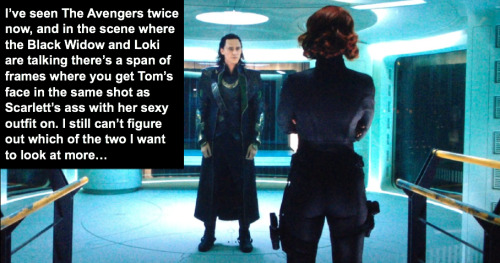
ETA: There has been a bit of discussion about the relative objectification of Black Widow compared with Catwoman in The Dark Knight Rises. It did strike me when watching the latter that the Nolans were overtly taking care to ensure that Anne Hathaway was never sexualised by the film itself, only by characters in the film. On the other hand, The Avengers features a two-shot of Scarlett Johansson with Tom Hiddleston in which this happens (thank you internet). The thing to emphasise about the frame is that it does work on a character level — Black Widow as this rooted immovable object on which Loki is weaving his manipulative spells. But it also features a leather-clad arse squarely in the audience's face (i.e. a sexual object on which the audience are invited to...) POINT BEING, both of these things are going on. I guess for those not interested in Johansson's arse, the character stuff may be enough of a justification for the shot to be framed in this way, but I have to admit that it took me right out of the film. Points lost there, Mr. Whedon. Also, me.
Should say that I think in other respects Black Widow's character bests Catwoman's in the feminism game, in that the Nolans end up throwing Kyle at Batman as a consolation prize for his trials, while Romanoff is more self-defined throughout. It's tricky though, because both characters essentially conform to the same femme fatale archetype. I do like Whedon's decision to emphasize the way Black Widow consciously creates the impression of vulnerability in order to work loose the prizes she is after (an aaaage is spent establishing this trait at the beginning of the film). Using femininity as a way to exploit patriarchy for your own ends. It's not a new idea (you could argue the femme fatale archetype is built on this), but a good way of addressing her sexualisation in the future. Black Widow CHOOSES to be objectified. The impression of weakness is a weapon wielded from a place of strength.
Showing posts with label Christopher Nolan. Show all posts
Showing posts with label Christopher Nolan. Show all posts
16.8.12


7.8.12
The Dark Knight Rises
I had tempered my expectations for this, and they were met. The Dark Knight is one of my favourite films ever, but otherwise I am not much of a Nolan partisan, finding their work minus Heath Ledger impressively constructed but emotionally distant.
I was thinking a little bit about why that is. It's strange, because the Nolans have had the opportunity to work with very talented actors. Michael Caine, for example, has a couple of really intense scenes in the new Dark Knight Rises film. You cannot fault his performance, I think, but there is something in the way it is presented that robs it of impact, at least for me.
A film can be seen as being composed of five elements: plot, character, setting, theme and style (mise en scène might be the more appropriate term, but it is very pretentious. And French). The Nolans are master mechanics when building plot, and Inception might be the best showcase for their proficiency in this field. The Dark Knight Rises is also extremely busy plot-wise, despite the fact that it's near three hours long. Every scene is briskly efficient with moving the story along, and character-building is fitted around the necessity of getting from point A to B. So the swings in character arcs are sudden, and not always properly earned. When Alfred's tearful goodbye came up, I wasn't really connecting with the emotional content of the scene, just thinking the film needed to get rid of Alfred now. Plot takes precedence over character.
Of the five elements, plot is the least important for me. If a film has complex characters, intelligent themes, a well-designed world and an original style, I'll be ready to forgive lazy plotting, if I notice it at all. This is why the Nolans' intricate story constructions fail to dazzle me the way they do many others. I found Inception frustrating because it was a lot of hard work (I had to see the film twice to really understand what was happening) and it didn't leave me with very much at the end of it.
Just as an aside, I didn't much like the decision to end Inception on a question, which I thought was a tongue-in-cheek switch-around designed to break the fourth wall and get the audience thinking about films as compact inception operations. This is an interesting point, sure, but it also dissolves the film's dramatic resolution. I'm quite glad that Dark Knight Rises settles for a punchy statement instead.
Quite a lot of the discussion around The Dark Knight Rises has revolved around plot-holes, actually. I cannot add anything to it apart from to say that all the Batman films feature hair-brained Bond villain ridiculous schemes, and I admire the way the Nolans stay true to the ludicrous nature of the superhero genre whilst keeping the tone dark and gritty — a well-executed balancing act between realism and pulp.
What is interesting is that these plot-holes are standing out for people, despite the fact that the other films could be picked apart just as easily. I think this may be due to The Dark Knight Rises not managing to present a coherent theme which justifies the loopy story it is composed of, as The Dark Knight did. This is discussed in greater detail here and here, and I don't see the need to go over the same ground. Just to say that the exegesis around the use of images that recall Occupy and Al Qaeda is not facetious. Or if it is, the film-makers are to blame for putting the allusions there without making sense of them. The film ends up presenting a really weird axis of evil, worthy of the deranged Frank Miller. I suspect, as Film Crit Hulk does, that the Nolans were not consciously filling their film with right-wing paranoia. Their focus was squarely aimed on the character of Bruce Wayne and giving him a heroic, happy send-off. The Dark Knight Rises is about fan service and spectacle, and the suggestive allusions were thrown in with little thought.
28.1.12
The Prestige
A Nolan film's themes could be written on a napkin as far as I'm concerned. Storytelling as wish-fulfillment, basically. What the protagonist in Memento demonstrated is that people need their lies in order to live their lives. Batman is deceived about Rachel's intentions, Gotham is deceived about Batman -- all for the greater good, so people can be better people. Inception asks whether living in your dreams is preferable to reality, skewed by that last scene so the question becomes whether films are preferable as well. The Prestige is about filmmaking (as a friend of mine told me a long while ago). The three parts of a trick are like the three acts of a movie -- set-up to deliver audience satisfaction. Such manipulation is addictive -- one does it for the roar of the crowd, the other for the ingenuity of the thing itself. Both leave destruction in their wake. While the rivals look to uncover each other's secrets, Sarah wants the truth that really matters. As Inception suggests to the audience at the end -- family is better than all the dreams you can invent.
The Nolans' ideas are interesting, sure, but they do tend to make characters into props. Moreover, the tight control over the plot, the economical script, the utilitarian cinematography, fail to dazzle or astound me. The Nolans are mechanics that build ingenious storytelling machines, and however good their actors are, they never blast through the complex contraptions that surround them.
There is one exception, The Dark Knight, which I watched again not too long ago and am still wowed by. Others found the indulgence the Nolans allowed themselves to be a weakness. For me, the improbable scenarios building to ever more improbable scenarios created a kind of operatic swell that no other Nolan movie can match. It is the feeling of Heath Ledger's magisterial Joker asserting his will over Gotham, an entire city enraptured and terrified by this sinister charismatic presence, that goes down as their supreme achievement. And I have my doubts about whether The Dark Knight Rises will be able to match it.
Subscribe to:
Posts (Atom)