My problem with The Avengers is that Thor was too good. Specifically, Tom Hiddleston in Thor, whose performance I think matches the range and intensity of Heath Ledger's Joker. As Film Crit Hulk (my own film crit hero) points out, in The Avengers Loki serves to accentuate and develop the arcs of the six main characters. But this leaves less room to explore his own background and motivations.
Let's look at those anyway. From Thor, Hiddleston brings a feeling of resentment and ambition, but he also takes on something of the Red Skull's ideology in Captain America. Humans have weak minds imprisoned in frail bodies, and require a Nietzschean strong man to rule them. Happiness for most lies in the predictability of slavery — the alienation of the responsibility associated with free will.
And the way humanity decides to fight this evil is... to get a bunch of strong men to defend or avenge them. There is a tension here, which was brought out for me in a scene between Captain America and two cops, where the latter claim the responsibility of defending the innocent, before willingly divesting themselves of that responsibility as soon as Cap demonstrates his superior strength. This moment is played for laughs, and sure Cap's authority comes from charisma rather than fear — the fact that the Avengers use their power to defend freedom makes them the heroes. And the totemic idea of Phil as the rallying force behind the team gives an 'of the people' spin on their activities. I'm aware of all that. But when I remember Nietzsche's point that charisma is ultimately produced by fear, the vox pop platitudes at the end of the film leave me with some rather uncomfortable feelings.
Whedon's work always pits the small guys against the big evil. Without the army, Loki is just one big guy against six (which includes the Hulk). A more satisfying villain for Whedon would have been the shadowy (quite literally) cabal behind S.H.I.E.L.D, and the film takes some steps in that direction. Whedon undercuts Fury's endorsement of nuclear weapons; the problem of the alien invasion is solved without them. Retaliation is delivered in spite of what the Avengers were doing on the ground in Manhattan, and it is clear that it will have serious repercussions in the next film, as the strike draws the eye of Thanos. If Whedon is indeed to direct the sequel, I expect extraterrestrials will not be the only antagonists the new team will have to face.
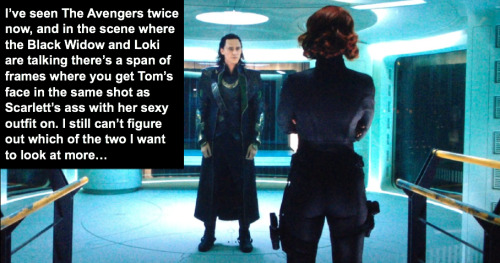
ETA: There has been a bit of discussion about the relative objectification of Black Widow compared with Catwoman in The Dark Knight Rises. It did strike me when watching the latter that the Nolans were overtly taking care to ensure that Anne Hathaway was never sexualised by the film itself, only by characters in the film. On the other hand, The Avengers features a two-shot of Scarlett Johansson with Tom Hiddleston in which this happens (thank you internet). The thing to emphasise about the frame is that it does work on a character level — Black Widow as this rooted immovable object on which Loki is weaving his manipulative spells. But it also features a leather-clad arse squarely in the audience's face (i.e. a sexual object on which the audience are invited to...) POINT BEING, both of these things are going on. I guess for those not interested in Johansson's arse, the character stuff may be enough of a justification for the shot to be framed in this way, but I have to admit that it took me right out of the film. Points lost there, Mr. Whedon. Also, me.
Should say that I think in other respects Black Widow's character bests Catwoman's in the feminism game, in that the Nolans end up throwing Kyle at Batman as a consolation prize for his trials, while Romanoff is more self-defined throughout. It's tricky though, because both characters essentially conform to the same femme fatale archetype. I do like Whedon's decision to emphasize the way Black Widow consciously creates the impression of vulnerability in order to work loose the prizes she is after (an aaaage is spent establishing this trait at the beginning of the film). Using femininity as a way to exploit patriarchy for your own ends. It's not a new idea (you could argue the femme fatale archetype is built on this), but a good way of addressing her sexualisation in the future. Black Widow CHOOSES to be objectified. The impression of weakness is a weapon wielded from a place of strength.
Showing posts with label Captain America. Show all posts
Showing posts with label Captain America. Show all posts
16.8.12


12.8.11
Captain America: The First Avenger
I did the rant about 3D before, so won't waste words here. At least this film was more colourful than Harry Potter, so I could actually SEE the action sequences. Which was good, because they were extremely enjoyable. As was everything else.
There is absolutely nothing original in this film. Plot-points, characters, themes are all recognizable repeats from previous adventure, SF and war movies. What you get is more of them, and faster. Nazi scientists to laser guns to train heist to death scene to interrogation scene to motorbike-chase and so on.
Rarely have I seen a film go through the motions with such poise. Characters are as flat as cardboard, straight out of Hollywood history, but their lines are carefully balanced between sincere and arch, and are delivered with sharp timing. Not once did I wince, and I laughed quite a lot. Tommy Lee Jones seemed to be having a blast handing out deadpan putdowns to all and sundry, but he could also eat his words without having his authority undermined. Bucky was super suave as the playboy in the uniform, but his superior / inferior / ultimately loyal relationship with Steve Rodgers was also handled very well. Poor Peggy got stuck with the thankless romantic-interest role, but the film pushed the gushy stuff between the lines, so Hayley Atwell was allowed to be an adult and kick some ass as well as flirt and get jealous. Bit like Thor, tho, that kiss came out of nowhere (and at such a silly moment!). Better to have left it with arranging a date, but I'm guessing the film-makers lost that battle.
But really, Chris Evans carries this one on the back of his giant super-soldier shoulders. You couldn't have just got a smiling tank like Chris Hemsworth to play the role. Even when Cap acquires the bod, the face has to remain humble and honest. As a skinny, delusional glory-seeker, you still believe Rodgers has that quiet determination and bravery that would make him an inspiration. Chris Evans manages to convey a faith-in-oneself despite the failures and rejections life has brought, a faith born out of a simple but rigorous sense of what's right. When he speaks to Peggy, he is (or very quickly becomes) sure of himself, so you get the feeling that the reason he hasn't got the women before is because they haven't been listening. Bucky does shoot back the suggestion that Rodgers's ambition is fueled by a sense of inadequacy, but again, Evans's performance contradicts that reading. It's more simple than that. Rodgers wants to fight because he's the hero.
And Hugo Weaving wants to destroy the world because he's the villain ... pretty much. The thematic line being fed is the question of how to deal with power. The Red Skull is an Nietzschean strongman with the will to dominate all weaker forms of life. Hydra is the mindless, numberless force he assembles, and whose existence he defines and directs. On the other side there's Steve Rodgers, an ordinary kid given extraordinary abilities, and grateful for them, and with humility intact. He's been beaten up all his life, and now has the opportunity to fight the bullies back, on a global scale. The people he assembles around him aren't faceless, but diverse, and with personality streaming out of every pore. It's the free world against totalitarian terror. A time when things really were that simple.
But the film is also an extended origin story, because Cap wakes up in a new world where the bullies and the honest jons are much more difficult to tell apart. The opening and concluding scenes undermine the genre stereotypes and period fittings the film riffed on (much better than First Class did, btw), and hopefully set up a more complicated Captain America that we will see in The Avengers next year.
Subscribe to:
Posts (Atom)