I read Lord of the Flies in school, which I imagine provides the model for this film (I haven't seen Battle Royale) – children killing each other in the wild, basically. But while Golding was interested in the darkness of man's heart, The Hunger Games goes in an Orwellian direction, exploring economic exploitation and the methods of social control used to dampen resistance to it. In other words, it's a political fable, with the kind of radical politics that I'm seeing a lot more of recently (cf. Snow White cast as a revolutionary).
The hero, Katniss Everdeen, is introduced as a Robin Hood figure, illegally hunting in the king's forests. Her display of fortitude and dignity in the contest she enters turns her into a symbol of rebellion against an authoritarian regime (Wes Bentley the Duke of Nottingham to Donald Sutherland's King John), although we'll have to wait for the next adaptation before we see her at the vanguard of an army. I'm guessing, btw. I haven't read the books.
The games are an interesting tool of ideological subjugation, their logic isn't spelled out by the film, and I'm still trying to tease it out (perhaps I really should read the books). Donald Sutherland mentions that the only thing more powerful that fear is hope, which to me suggests an analogy with the myth of the American Dream. The 'tribute' is forced to ruthlessly compete to the death in order to win fame and riches. The reality, of course, is that the rules are always stacked against them, and the privileged are shielded from the bloodbath.
If the arena is used as a microcosm for capitalist society, the analogy is sophisticated. Candidates compete on marketability as much as on survival skills. The audience don't just want spectacle, but character. The clever thing about the film is that Katniss and Peeta win the game by rejecting the dictates of competition, but in doing so they are forced into roles in another narrative chosen for them – star-crossed lovers going down together rather than tearing each other apart. And Katniss clearly isn't comfortable playing along. The film's ending is both triumphant and disquieting, since the hero survives but isn't free.
Some criticism has been levelled at the film's shakey camerawork and use of close-ups. Milage may vary on this, but I though all the action scenes were perfectly explicable, and thus well presented. Sure the camerawork was often used to convey the subjective experience of Katniss – not only the adrenaline-soaked thrills, but the moments of delirium, confusion, anger, serenity. It was effective. Not only that, but I liked the ragged montage at the beginning introducing us to District 12, and the contrast made with the glitzy stage and the clinically smooth shots of the puppet masters in the Capitol. Not a new idea, but a good one. The film as a whole was expertly put together, and one of the finest I've seen this year.
28.9.12

23.9.12
Moby Dick; or, the White Whale
Finished it a while ago, but was too busy / disorganised to get any thoughts down on here, so I'm going with memory, the highlights I made on my kindle, and the short update posts I've left on Whitechapel's The Book Club 2012 thread.
First, Ahab, who is actually less of a presence in the novel than I expected, and whose motivation was surprisingly easy to understand. It's all in this passage below:
The adjective that keeps cropping up with Ahab is "monomaniac", which serves as a useful contrast with the narrator and reigning principal of the novel, Ishmael. While Ahab's quest for vengeance supplies the propulsive narrative force of the novel, this keeps getting destabilised by the circling centrifugal nature of Ishmael's narration. Moreover, while Ahab supplies a singular reading of Moby Dick's significance, Ishmael's digressions concoct a heap of different allusions and conclusions bolted on to the whale, a lot of them (to me anyway) quite trite and unfulfilling. He is a mind at play, unbound by ideological or linguistic orthodoxies, delighting in everything around him (and mischievously undermining the veracity of his account). I think Melville didn't have to add that final epilogue explaining how Ishmael survives. It would have completed his ascension to the all-embracing, omnipresent consciousness he was moving toward through the book – from the individualistic self-definition of 'Call me Ishmael' to being dissolved into the sea and becoming one with the story he is telling.
I found the tone of the beginning of the novel to be unexpectedly wry and whimsical. A welcome surprise, but Ishmael's subsequent lack of focus on the ship became very tedious. I was left wishing that many more chapters fell under the heading of "sundry mystifications too tedious to detail". Melville tests the reader's patience in deciding to demonstrate Ishmael's irreverence and sense of wonder so comprehensively. Large sections of the book left me restless. The experiment of living provided by Ishmael, while maybe more admirable, was not that much more attractive than the experiment of living provided by Ahab, and I don't think Melville intended the two to cancel each other out.
First, Ahab, who is actually less of a presence in the novel than I expected, and whose motivation was surprisingly easy to understand. It's all in this passage below:
Hark ye yet again—the little lower layer. All visible objects, man, are but as pasteboard masks. But in each event — in the living act, the undoubted deed — there, some unknown but still reasoning thing puts forth the mouldings of its features from behind the unreasoning mask. If man will strike, strike through the mask! How can the prisoner reach outside except by thrusting through the wall? To me, the white whale is that wall, shoved near to me. Sometimes I think there's naught beyond. But 'tis enough. He tasks me; he heaps me; I see in him outrageous strength, with an inscrutable malice sinewing it. That inscrutable thing is chiefly what I hate; and be the white whale agent, or be the white whale principal, I will wreak that hate upon him. Talk not to me of blasphemy, man; I'd strike the sun if it insulted me. For could the sun do that, then could I do the other; since there is ever a sort of fair play herein, jealousy presiding over all creations. But not my master, man, is even that fair play. Who's over me? Truth hath no confines.The whale to Ahab represents that "outrageous strength" and "inscrutable malice" that built a universe which inflicts arbitrary punishment on its sentient inhabitants. His crusade is against a God that has left an imperfect creation for his creatures. And it's not the punishment, so much as the fact that its arbitrary, that incites Ahab's fury. This questioning of divine order is why the voyage is impious and blasphemous. Not only that, but Ahab is actually unsure if natural evil is animated by a hidden rational power – perhaps it's just arbitrary. It doesn't matter, fair play demands that Ahab fight the imbalance. The final part of the passage is a bit garbled, but it suggests that Ahab questions the notion of fair play as well, the "Truth" trumps it. But he reels himself back from such doubts, and goes on to address Starbuck's defiance.
The adjective that keeps cropping up with Ahab is "monomaniac", which serves as a useful contrast with the narrator and reigning principal of the novel, Ishmael. While Ahab's quest for vengeance supplies the propulsive narrative force of the novel, this keeps getting destabilised by the circling centrifugal nature of Ishmael's narration. Moreover, while Ahab supplies a singular reading of Moby Dick's significance, Ishmael's digressions concoct a heap of different allusions and conclusions bolted on to the whale, a lot of them (to me anyway) quite trite and unfulfilling. He is a mind at play, unbound by ideological or linguistic orthodoxies, delighting in everything around him (and mischievously undermining the veracity of his account). I think Melville didn't have to add that final epilogue explaining how Ishmael survives. It would have completed his ascension to the all-embracing, omnipresent consciousness he was moving toward through the book – from the individualistic self-definition of 'Call me Ishmael' to being dissolved into the sea and becoming one with the story he is telling.
I found the tone of the beginning of the novel to be unexpectedly wry and whimsical. A welcome surprise, but Ishmael's subsequent lack of focus on the ship became very tedious. I was left wishing that many more chapters fell under the heading of "sundry mystifications too tedious to detail". Melville tests the reader's patience in deciding to demonstrate Ishmael's irreverence and sense of wonder so comprehensively. Large sections of the book left me restless. The experiment of living provided by Ishmael, while maybe more admirable, was not that much more attractive than the experiment of living provided by Ahab, and I don't think Melville intended the two to cancel each other out.
8.9.12
The NeverEnding Story
This is like the urtext for two of my favourite fantasy films: MirrorMask and (to a lesser extent) Pan's Labyrinth. It's not as complex as either of those two films, however. The ending is particularly problematic, being a wholesale endorsement of make-believe as wish-fulfillment – the only way to deal with bullying is to escape into a flight of fancy where your pet dragon chases your tormentors into a skip.
The most interesting part of the film is the way it uses symbol to infer some rather unsettling ideas. The twin sphinxes as female sexual predators, their imperious gaze uncovering male doubt, annihilating male potency. The mirror which reveals the whimpering boy behind the all-conquering hero. More of that darker aspect of fantasy would have been welcome. But I guess there's only so much you can get away with in a film for children.
The most interesting part of the film is the way it uses symbol to infer some rather unsettling ideas. The twin sphinxes as female sexual predators, their imperious gaze uncovering male doubt, annihilating male potency. The mirror which reveals the whimpering boy behind the all-conquering hero. More of that darker aspect of fantasy would have been welcome. But I guess there's only so much you can get away with in a film for children.
16.8.12
The Avengers
My problem with The Avengers is that Thor was too good. Specifically, Tom Hiddleston in Thor, whose performance I think matches the range and intensity of Heath Ledger's Joker. As Film Crit Hulk (my own film crit hero) points out, in The Avengers Loki serves to accentuate and develop the arcs of the six main characters. But this leaves less room to explore his own background and motivations.
Let's look at those anyway. From Thor, Hiddleston brings a feeling of resentment and ambition, but he also takes on something of the Red Skull's ideology in Captain America. Humans have weak minds imprisoned in frail bodies, and require a Nietzschean strong man to rule them. Happiness for most lies in the predictability of slavery — the alienation of the responsibility associated with free will.
And the way humanity decides to fight this evil is... to get a bunch of strong men to defend or avenge them. There is a tension here, which was brought out for me in a scene between Captain America and two cops, where the latter claim the responsibility of defending the innocent, before willingly divesting themselves of that responsibility as soon as Cap demonstrates his superior strength. This moment is played for laughs, and sure Cap's authority comes from charisma rather than fear — the fact that the Avengers use their power to defend freedom makes them the heroes. And the totemic idea of Phil as the rallying force behind the team gives an 'of the people' spin on their activities. I'm aware of all that. But when I remember Nietzsche's point that charisma is ultimately produced by fear, the vox pop platitudes at the end of the film leave me with some rather uncomfortable feelings.
Whedon's work always pits the small guys against the big evil. Without the army, Loki is just one big guy against six (which includes the Hulk). A more satisfying villain for Whedon would have been the shadowy (quite literally) cabal behind S.H.I.E.L.D, and the film takes some steps in that direction. Whedon undercuts Fury's endorsement of nuclear weapons; the problem of the alien invasion is solved without them. Retaliation is delivered in spite of what the Avengers were doing on the ground in Manhattan, and it is clear that it will have serious repercussions in the next film, as the strike draws the eye of Thanos. If Whedon is indeed to direct the sequel, I expect extraterrestrials will not be the only antagonists the new team will have to face.
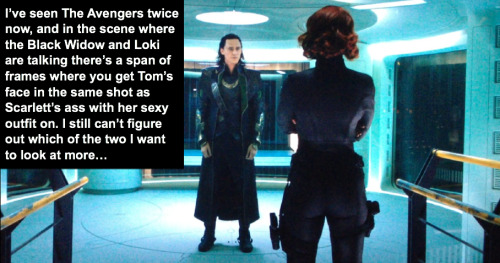
ETA: There has been a bit of discussion about the relative objectification of Black Widow compared with Catwoman in The Dark Knight Rises. It did strike me when watching the latter that the Nolans were overtly taking care to ensure that Anne Hathaway was never sexualised by the film itself, only by characters in the film. On the other hand, The Avengers features a two-shot of Scarlett Johansson with Tom Hiddleston in which this happens (thank you internet). The thing to emphasise about the frame is that it does work on a character level — Black Widow as this rooted immovable object on which Loki is weaving his manipulative spells. But it also features a leather-clad arse squarely in the audience's face (i.e. a sexual object on which the audience are invited to...) POINT BEING, both of these things are going on. I guess for those not interested in Johansson's arse, the character stuff may be enough of a justification for the shot to be framed in this way, but I have to admit that it took me right out of the film. Points lost there, Mr. Whedon. Also, me.
Should say that I think in other respects Black Widow's character bests Catwoman's in the feminism game, in that the Nolans end up throwing Kyle at Batman as a consolation prize for his trials, while Romanoff is more self-defined throughout. It's tricky though, because both characters essentially conform to the same femme fatale archetype. I do like Whedon's decision to emphasize the way Black Widow consciously creates the impression of vulnerability in order to work loose the prizes she is after (an aaaage is spent establishing this trait at the beginning of the film). Using femininity as a way to exploit patriarchy for your own ends. It's not a new idea (you could argue the femme fatale archetype is built on this), but a good way of addressing her sexualisation in the future. Black Widow CHOOSES to be objectified. The impression of weakness is a weapon wielded from a place of strength.
Let's look at those anyway. From Thor, Hiddleston brings a feeling of resentment and ambition, but he also takes on something of the Red Skull's ideology in Captain America. Humans have weak minds imprisoned in frail bodies, and require a Nietzschean strong man to rule them. Happiness for most lies in the predictability of slavery — the alienation of the responsibility associated with free will.
And the way humanity decides to fight this evil is... to get a bunch of strong men to defend or avenge them. There is a tension here, which was brought out for me in a scene between Captain America and two cops, where the latter claim the responsibility of defending the innocent, before willingly divesting themselves of that responsibility as soon as Cap demonstrates his superior strength. This moment is played for laughs, and sure Cap's authority comes from charisma rather than fear — the fact that the Avengers use their power to defend freedom makes them the heroes. And the totemic idea of Phil as the rallying force behind the team gives an 'of the people' spin on their activities. I'm aware of all that. But when I remember Nietzsche's point that charisma is ultimately produced by fear, the vox pop platitudes at the end of the film leave me with some rather uncomfortable feelings.
Whedon's work always pits the small guys against the big evil. Without the army, Loki is just one big guy against six (which includes the Hulk). A more satisfying villain for Whedon would have been the shadowy (quite literally) cabal behind S.H.I.E.L.D, and the film takes some steps in that direction. Whedon undercuts Fury's endorsement of nuclear weapons; the problem of the alien invasion is solved without them. Retaliation is delivered in spite of what the Avengers were doing on the ground in Manhattan, and it is clear that it will have serious repercussions in the next film, as the strike draws the eye of Thanos. If Whedon is indeed to direct the sequel, I expect extraterrestrials will not be the only antagonists the new team will have to face.
ETA: There has been a bit of discussion about the relative objectification of Black Widow compared with Catwoman in The Dark Knight Rises. It did strike me when watching the latter that the Nolans were overtly taking care to ensure that Anne Hathaway was never sexualised by the film itself, only by characters in the film. On the other hand, The Avengers features a two-shot of Scarlett Johansson with Tom Hiddleston in which this happens (thank you internet). The thing to emphasise about the frame is that it does work on a character level — Black Widow as this rooted immovable object on which Loki is weaving his manipulative spells. But it also features a leather-clad arse squarely in the audience's face (i.e. a sexual object on which the audience are invited to...) POINT BEING, both of these things are going on. I guess for those not interested in Johansson's arse, the character stuff may be enough of a justification for the shot to be framed in this way, but I have to admit that it took me right out of the film. Points lost there, Mr. Whedon. Also, me.
Should say that I think in other respects Black Widow's character bests Catwoman's in the feminism game, in that the Nolans end up throwing Kyle at Batman as a consolation prize for his trials, while Romanoff is more self-defined throughout. It's tricky though, because both characters essentially conform to the same femme fatale archetype. I do like Whedon's decision to emphasize the way Black Widow consciously creates the impression of vulnerability in order to work loose the prizes she is after (an aaaage is spent establishing this trait at the beginning of the film). Using femininity as a way to exploit patriarchy for your own ends. It's not a new idea (you could argue the femme fatale archetype is built on this), but a good way of addressing her sexualisation in the future. Black Widow CHOOSES to be objectified. The impression of weakness is a weapon wielded from a place of strength.
13.8.12
Prometheus
Nothing these characters do seems to make sense. For sure. I mean, the film just has the stupidest scientists ever. Damning in a project that has this much money, and such a renowned legacy to live up to. With that in mind, these basic lapses become unforgivable. This film is an abject failure in formal terms.
And yet, and yet...
I caught quite a late screening, and went straight home to bed afterwards. And I dreamed about it, vividly. The dream didn't repeat any of the scenarios or visuals in the film. To be honest, my dream was in many respects more awesome – featuring a reanimated tyrannosaurus rex imbued with a human consciousness, and a perpetual survivor protagonist like Abélard Lindsay from Schismatrix, who is there to observe the decay and death of the human race (I think some sort of wish fulfillment on my part maybe). It was all very Grant Morrison telling tales of the dying Earth. I wish I could remember more of it. Unfortunately, the dream was SO awesome it woke me up in the middle of the night. I made a concerted effort to memorize as much as possible and then promptly went back to sleep, so that failed. Anyway, the emotional state created by the film obviously has some kind of staying power, which was carried over into my sleeping life.
One line from the film in particular sent me down this rabbit hole. Paraphrased: "they created us and now they want to kill us, I need to know why". It got me thinking about the desire to understand your origin and the origin of the universe, and how this has manifested historically in the imagination of great benevolent beings that have sacrificed themselves to bring about life. The opening sequence of the film makes this Promethean myth literal. But the universe these gods have created, not to mention the very stuff of humanity, is dangerous. The gods are not only capricious but murderously so. The void beyond our tiny planet is an inhospitable nightmare. The universe is not benevolent. It is out to kill us. We are now facing down an environmental cataclysm that may very well lead to our annihilation. We now have the technological capacity to wipe out our entire civilization. Like the Engineers in this film, if we are not careful our weapons may be the end of us.
For me, the film is less about the act of creation and more about the feeling of being created, without knowing the reasons why, and the slowly dawning realization that we may become extinct NEVER knowing the reasons why. It reminds me of that time as a teenager when I was grappling with these questions. Specifically, I remember reading about the impact a supervolcano or a meteor can have on the Earth, and recoiling in horror at the possibility of so much unaccountable human death. Emotionally, I had to convince myself that such colossal meaningless destruction would never be allowed to happen, something must exist to prevent it. I couldn't otherwise cope or process that glimpse into the very purposelessness of existence. It was a kind of existential nausea, perhaps. Or maybe something closer to Lovecraftian cosmic horror.
Alien may owe something to Lovecraft, I don't know – the cold iron maiden embrace of deep space. The xenomorph was also a creature of single-minded predatory sexuality, an image of the most destructive, dehumanizing aspects of the human psyche. Both of these ideas are in Prometheus, although actually its most terrifying scene is the med-pod sequence where Shaw gives birth to a totally repellent, rapacious squid creature. The body horror was so acute I had to look away from the screen for several seconds (and I thought I was relatively inured to scary movies by now). If it alludes to the virgin birth, it is all the more irreverent and disconcerting: suggesting in stark terms that humans have the capacity to spawn mewling needy selfish monsters, and that mothers may find their children utterly inexplicable and disgusting.
Film Crit Hulk, whose writing I have recently discovered and have fallen very hard for (dude is so otm on everything), has argued that the film's insistence that the gods do not explain their ways to man, whilst being a worthy theme, also necessarily leads to unsatisfying drama. Instead, Lindelof should have had the courage to supply his own explanation in the face of a meaningless reality – human beings having always created meaning through storytelling and artistic endeavour. I don't think that advice is correct, because despite the endless idiocy of the characters and the senselessness of the plot, the ideas behind the film still managed to evoke a very strong emotional response, at least for me (as I have indicated, I'm rather susceptible to the concerns of this film). I think there could have been a way to fix the mechanics of the film's story whilst preserving the thematic foundation which Lindelof pitched for the film, and which supplies its peculiar horror. We shouldn't discount the possibility that Lindelof is a good guy with interesting ideas who just isn't very good at the nuts and bolts of storytelling.
And yet, and yet...
I caught quite a late screening, and went straight home to bed afterwards. And I dreamed about it, vividly. The dream didn't repeat any of the scenarios or visuals in the film. To be honest, my dream was in many respects more awesome – featuring a reanimated tyrannosaurus rex imbued with a human consciousness, and a perpetual survivor protagonist like Abélard Lindsay from Schismatrix, who is there to observe the decay and death of the human race (I think some sort of wish fulfillment on my part maybe). It was all very Grant Morrison telling tales of the dying Earth. I wish I could remember more of it. Unfortunately, the dream was SO awesome it woke me up in the middle of the night. I made a concerted effort to memorize as much as possible and then promptly went back to sleep, so that failed. Anyway, the emotional state created by the film obviously has some kind of staying power, which was carried over into my sleeping life.
One line from the film in particular sent me down this rabbit hole. Paraphrased: "they created us and now they want to kill us, I need to know why". It got me thinking about the desire to understand your origin and the origin of the universe, and how this has manifested historically in the imagination of great benevolent beings that have sacrificed themselves to bring about life. The opening sequence of the film makes this Promethean myth literal. But the universe these gods have created, not to mention the very stuff of humanity, is dangerous. The gods are not only capricious but murderously so. The void beyond our tiny planet is an inhospitable nightmare. The universe is not benevolent. It is out to kill us. We are now facing down an environmental cataclysm that may very well lead to our annihilation. We now have the technological capacity to wipe out our entire civilization. Like the Engineers in this film, if we are not careful our weapons may be the end of us.
For me, the film is less about the act of creation and more about the feeling of being created, without knowing the reasons why, and the slowly dawning realization that we may become extinct NEVER knowing the reasons why. It reminds me of that time as a teenager when I was grappling with these questions. Specifically, I remember reading about the impact a supervolcano or a meteor can have on the Earth, and recoiling in horror at the possibility of so much unaccountable human death. Emotionally, I had to convince myself that such colossal meaningless destruction would never be allowed to happen, something must exist to prevent it. I couldn't otherwise cope or process that glimpse into the very purposelessness of existence. It was a kind of existential nausea, perhaps. Or maybe something closer to Lovecraftian cosmic horror.
Alien may owe something to Lovecraft, I don't know – the cold iron maiden embrace of deep space. The xenomorph was also a creature of single-minded predatory sexuality, an image of the most destructive, dehumanizing aspects of the human psyche. Both of these ideas are in Prometheus, although actually its most terrifying scene is the med-pod sequence where Shaw gives birth to a totally repellent, rapacious squid creature. The body horror was so acute I had to look away from the screen for several seconds (and I thought I was relatively inured to scary movies by now). If it alludes to the virgin birth, it is all the more irreverent and disconcerting: suggesting in stark terms that humans have the capacity to spawn mewling needy selfish monsters, and that mothers may find their children utterly inexplicable and disgusting.
Film Crit Hulk, whose writing I have recently discovered and have fallen very hard for (dude is so otm on everything), has argued that the film's insistence that the gods do not explain their ways to man, whilst being a worthy theme, also necessarily leads to unsatisfying drama. Instead, Lindelof should have had the courage to supply his own explanation in the face of a meaningless reality – human beings having always created meaning through storytelling and artistic endeavour. I don't think that advice is correct, because despite the endless idiocy of the characters and the senselessness of the plot, the ideas behind the film still managed to evoke a very strong emotional response, at least for me (as I have indicated, I'm rather susceptible to the concerns of this film). I think there could have been a way to fix the mechanics of the film's story whilst preserving the thematic foundation which Lindelof pitched for the film, and which supplies its peculiar horror. We shouldn't discount the possibility that Lindelof is a good guy with interesting ideas who just isn't very good at the nuts and bolts of storytelling.
7.8.12
The Dark Knight Rises
I had tempered my expectations for this, and they were met. The Dark Knight is one of my favourite films ever, but otherwise I am not much of a Nolan partisan, finding their work minus Heath Ledger impressively constructed but emotionally distant.
I was thinking a little bit about why that is. It's strange, because the Nolans have had the opportunity to work with very talented actors. Michael Caine, for example, has a couple of really intense scenes in the new Dark Knight Rises film. You cannot fault his performance, I think, but there is something in the way it is presented that robs it of impact, at least for me.
A film can be seen as being composed of five elements: plot, character, setting, theme and style (mise en scène might be the more appropriate term, but it is very pretentious. And French). The Nolans are master mechanics when building plot, and Inception might be the best showcase for their proficiency in this field. The Dark Knight Rises is also extremely busy plot-wise, despite the fact that it's near three hours long. Every scene is briskly efficient with moving the story along, and character-building is fitted around the necessity of getting from point A to B. So the swings in character arcs are sudden, and not always properly earned. When Alfred's tearful goodbye came up, I wasn't really connecting with the emotional content of the scene, just thinking the film needed to get rid of Alfred now. Plot takes precedence over character.
Of the five elements, plot is the least important for me. If a film has complex characters, intelligent themes, a well-designed world and an original style, I'll be ready to forgive lazy plotting, if I notice it at all. This is why the Nolans' intricate story constructions fail to dazzle me the way they do many others. I found Inception frustrating because it was a lot of hard work (I had to see the film twice to really understand what was happening) and it didn't leave me with very much at the end of it.
Just as an aside, I didn't much like the decision to end Inception on a question, which I thought was a tongue-in-cheek switch-around designed to break the fourth wall and get the audience thinking about films as compact inception operations. This is an interesting point, sure, but it also dissolves the film's dramatic resolution. I'm quite glad that Dark Knight Rises settles for a punchy statement instead.
Quite a lot of the discussion around The Dark Knight Rises has revolved around plot-holes, actually. I cannot add anything to it apart from to say that all the Batman films feature hair-brained Bond villain ridiculous schemes, and I admire the way the Nolans stay true to the ludicrous nature of the superhero genre whilst keeping the tone dark and gritty — a well-executed balancing act between realism and pulp.
What is interesting is that these plot-holes are standing out for people, despite the fact that the other films could be picked apart just as easily. I think this may be due to The Dark Knight Rises not managing to present a coherent theme which justifies the loopy story it is composed of, as The Dark Knight did. This is discussed in greater detail here and here, and I don't see the need to go over the same ground. Just to say that the exegesis around the use of images that recall Occupy and Al Qaeda is not facetious. Or if it is, the film-makers are to blame for putting the allusions there without making sense of them. The film ends up presenting a really weird axis of evil, worthy of the deranged Frank Miller. I suspect, as Film Crit Hulk does, that the Nolans were not consciously filling their film with right-wing paranoia. Their focus was squarely aimed on the character of Bruce Wayne and giving him a heroic, happy send-off. The Dark Knight Rises is about fan service and spectacle, and the suggestive allusions were thrown in with little thought.
I was thinking a little bit about why that is. It's strange, because the Nolans have had the opportunity to work with very talented actors. Michael Caine, for example, has a couple of really intense scenes in the new Dark Knight Rises film. You cannot fault his performance, I think, but there is something in the way it is presented that robs it of impact, at least for me.
A film can be seen as being composed of five elements: plot, character, setting, theme and style (mise en scène might be the more appropriate term, but it is very pretentious. And French). The Nolans are master mechanics when building plot, and Inception might be the best showcase for their proficiency in this field. The Dark Knight Rises is also extremely busy plot-wise, despite the fact that it's near three hours long. Every scene is briskly efficient with moving the story along, and character-building is fitted around the necessity of getting from point A to B. So the swings in character arcs are sudden, and not always properly earned. When Alfred's tearful goodbye came up, I wasn't really connecting with the emotional content of the scene, just thinking the film needed to get rid of Alfred now. Plot takes precedence over character.
Of the five elements, plot is the least important for me. If a film has complex characters, intelligent themes, a well-designed world and an original style, I'll be ready to forgive lazy plotting, if I notice it at all. This is why the Nolans' intricate story constructions fail to dazzle me the way they do many others. I found Inception frustrating because it was a lot of hard work (I had to see the film twice to really understand what was happening) and it didn't leave me with very much at the end of it.
Just as an aside, I didn't much like the decision to end Inception on a question, which I thought was a tongue-in-cheek switch-around designed to break the fourth wall and get the audience thinking about films as compact inception operations. This is an interesting point, sure, but it also dissolves the film's dramatic resolution. I'm quite glad that Dark Knight Rises settles for a punchy statement instead.
Quite a lot of the discussion around The Dark Knight Rises has revolved around plot-holes, actually. I cannot add anything to it apart from to say that all the Batman films feature hair-brained Bond villain ridiculous schemes, and I admire the way the Nolans stay true to the ludicrous nature of the superhero genre whilst keeping the tone dark and gritty — a well-executed balancing act between realism and pulp.
What is interesting is that these plot-holes are standing out for people, despite the fact that the other films could be picked apart just as easily. I think this may be due to The Dark Knight Rises not managing to present a coherent theme which justifies the loopy story it is composed of, as The Dark Knight did. This is discussed in greater detail here and here, and I don't see the need to go over the same ground. Just to say that the exegesis around the use of images that recall Occupy and Al Qaeda is not facetious. Or if it is, the film-makers are to blame for putting the allusions there without making sense of them. The film ends up presenting a really weird axis of evil, worthy of the deranged Frank Miller. I suspect, as Film Crit Hulk does, that the Nolans were not consciously filling their film with right-wing paranoia. Their focus was squarely aimed on the character of Bruce Wayne and giving him a heroic, happy send-off. The Dark Knight Rises is about fan service and spectacle, and the suggestive allusions were thrown in with little thought.
5.8.12



1.8.12
29.7.12
Mala
To see what the fuss is about, since the guy is revered as the wise man on the mountain by a lot of UK dance producers, I watched Mala's Red Bull Music Academy lecture recently. It's a great watch, a whole hour in which interesting questions are put to a thoughtful producer in front of a broad audience. And for sure, Mala's integrity and conscientiousness are extraordinary and admirable. However, I found some of the positions he was taking puzzling and frustrating, which prevented me from getting sucked into the mystique.
First of all, and I'm sure this has been argued extensively already, but it bears repeating: naming something does not necessarily limit your ability to understand it. This is very much the historian in me asserting that everything is a part of history and situated in a context that helps explain it. Therefore understanding a work involves understanding the connections between it and its environment. I think an audience should be trusted to do this without facing insinuations that they are somehow diluting the purity of the way they listen to music. Giving something a name does not automatically reduce the intensity of your experience of it. Music can be thought about as well as felt, and there is value to both pursuits.
Plus I smell hubris whenever an artist declares that their work cannot be 'put in a box' or defined in relation to other works. Implicit in the claim that a work is indefinable is the suggestion that all that other stuff that has a name is somehow stale and inferior. Mala is probably aware of the genre = generic trap, and explicitly laments the fact that any music is pigeon-holed by the media machine. But even without its nefarious influence, how are people to talk about the music scene they are part of? Common sense demands that they refer to it by some term. If the artists involved themselves are unwilling to provide one, others will.* That may be the underlining problem: your product is being defined and disseminated without your control. But this is an inevitability Mala is aware of: music takes on a life of its own. Once you put it out there, to some extent it stops being yours. And your audience has given it a name. Nothing strange about that.
[*Interesting in this respect the contrast with grime, where Wot Do U Call It? generated a bunch of names (sub low, 8 bar), and where Wiley actually tried to stamp his own brand on the music (eski beat). But once a consensus term was established everyone fell into line, including Wiley, who has started calling himself the King Of Grime (with some justice).]
If anything, I would say loyalty to a cultural legacy that imposes a very rigid and inflexible distribution model for your work (dubplates, pirate radio, limited runs of vinyl) encourages it to be put in a box whatever it sounds like. Signalling your respect for a certain tradition by emulating its rituals clearly marks you off and encourages others to form certain very clear associations. Compare this to the relative anonymity of an MP3 streamed or downloaded from the internet, which (if you're lucky) may come with the name of an album and a small image of its front cover. There is less to latch onto, fewer associations you can make, when you are exposed to music in this way.
To me vinyl looks cumbersome and expensive. True, when I have seen a favourite album in that big package I think I've glimpsed some of what vinyl-fetishists find so alluring about the format. But I'm also suspicious of those feelings, since I have this idea that music should be able to stand alone without needing the material around it to have an effect.* So the only argument for vinyl that makes sense to me is the quality of sound it produces, and as I'm not enough of an audiophile to really appreciate the difference vinyl makes, I'm happy to leave it aside for cheaper alternatives.
[*This can be construed as naïveté on my part, since there is a context to the consumption of music as well as the production of it, which can have a pretty huge impact on your appreciation of that music. And actually the format in which that music is presented (a record, a cassette) can be seen as a feeble attempt to exert some kind of control over that experience. But that control is weak. Other factors (taste, emotional state, the weather) exert a much stronger influence, I would argue.]
I'm going on about vinyl not because I want people to stop buying it, only to point out why I don't. In fact one of the things that I really value about labels that put out vinyl is that the effort and expense required means that releases are few and well thought out (unlike MP3-centred scenes like glo-fi or hip hop where there is a staggering amount of material to trawl through). I'm lucky in that most uk dance labels (incl. favourites like Butterz and Hessle) give their audience a choice of format. It's the restriction of choice that I find frustrating.
And it is an impotent kind of frustration, since I realise that creators can and should be able to present their work in whatever way they think best. All I can do is point out that consciously limiting your output to a certain format doesn't strike me as a particularly open and welcoming attitude to have. This comes out more forcefully in an interview with Loefah, where he identifies vinyl-buyers as the real 'hardcore' – the audience his label Swamp81 is targeting. Which I think is wrong-headed, in that buying vinyl may correlate with a certain respect for music, but not absolutely so. This means you may not be reaching some of the 'hardcore' who for whatever reason don't buy records.*
[*I wouldn't say I identify with Loefah's 'hardcore', btw. I'm more of a skittish dilettante when it comes to dubstep and its offshoots. My allegiance to grime is firmer, not least because I admire its expansionist drive.]
More generally, there is something cliquey about the 'this is for the people that know' declarations, and something precious about the 'we are not looking for attention' assurances. Why would you want to limit the exposure to your work to those that 'deserve' it? This was brought out for me in Mala's repeated insistence that the seminal Haunted / Anti War Dub release will never be repressed, in the face of one questioner who was clearly eager to have a copy. I think there is something unwholesomely inward-looking about the preference to protect and buttress the value of your record for the people that already own it, as opposed to allowing new people to attach a value to it as well.*
[*Not to mention the kind of market distortions and unsavoury speculative behaviour you get when you restrict supply in this way.]
Should repeat again that Mala seems to me like an upstanding fellow, and he's responsible for beautiful things like 'Forgive' and 'Misty Winter', which automatically earn generous measures of my respect. I'm aware that launching what amounts to a series of cloaked ad hominems at him is not the best way of showing that, but I would stress that my rambling is less about Mala and more about myself, specifically why I can't buy into his point of view despite liking some of his work. And the work is good – that new Cuba album sounds primed for summer...
First of all, and I'm sure this has been argued extensively already, but it bears repeating: naming something does not necessarily limit your ability to understand it. This is very much the historian in me asserting that everything is a part of history and situated in a context that helps explain it. Therefore understanding a work involves understanding the connections between it and its environment. I think an audience should be trusted to do this without facing insinuations that they are somehow diluting the purity of the way they listen to music. Giving something a name does not automatically reduce the intensity of your experience of it. Music can be thought about as well as felt, and there is value to both pursuits.
Plus I smell hubris whenever an artist declares that their work cannot be 'put in a box' or defined in relation to other works. Implicit in the claim that a work is indefinable is the suggestion that all that other stuff that has a name is somehow stale and inferior. Mala is probably aware of the genre = generic trap, and explicitly laments the fact that any music is pigeon-holed by the media machine. But even without its nefarious influence, how are people to talk about the music scene they are part of? Common sense demands that they refer to it by some term. If the artists involved themselves are unwilling to provide one, others will.* That may be the underlining problem: your product is being defined and disseminated without your control. But this is an inevitability Mala is aware of: music takes on a life of its own. Once you put it out there, to some extent it stops being yours. And your audience has given it a name. Nothing strange about that.
[*Interesting in this respect the contrast with grime, where Wot Do U Call It? generated a bunch of names (sub low, 8 bar), and where Wiley actually tried to stamp his own brand on the music (eski beat). But once a consensus term was established everyone fell into line, including Wiley, who has started calling himself the King Of Grime (with some justice).]
If anything, I would say loyalty to a cultural legacy that imposes a very rigid and inflexible distribution model for your work (dubplates, pirate radio, limited runs of vinyl) encourages it to be put in a box whatever it sounds like. Signalling your respect for a certain tradition by emulating its rituals clearly marks you off and encourages others to form certain very clear associations. Compare this to the relative anonymity of an MP3 streamed or downloaded from the internet, which (if you're lucky) may come with the name of an album and a small image of its front cover. There is less to latch onto, fewer associations you can make, when you are exposed to music in this way.
To me vinyl looks cumbersome and expensive. True, when I have seen a favourite album in that big package I think I've glimpsed some of what vinyl-fetishists find so alluring about the format. But I'm also suspicious of those feelings, since I have this idea that music should be able to stand alone without needing the material around it to have an effect.* So the only argument for vinyl that makes sense to me is the quality of sound it produces, and as I'm not enough of an audiophile to really appreciate the difference vinyl makes, I'm happy to leave it aside for cheaper alternatives.
[*This can be construed as naïveté on my part, since there is a context to the consumption of music as well as the production of it, which can have a pretty huge impact on your appreciation of that music. And actually the format in which that music is presented (a record, a cassette) can be seen as a feeble attempt to exert some kind of control over that experience. But that control is weak. Other factors (taste, emotional state, the weather) exert a much stronger influence, I would argue.]
I'm going on about vinyl not because I want people to stop buying it, only to point out why I don't. In fact one of the things that I really value about labels that put out vinyl is that the effort and expense required means that releases are few and well thought out (unlike MP3-centred scenes like glo-fi or hip hop where there is a staggering amount of material to trawl through). I'm lucky in that most uk dance labels (incl. favourites like Butterz and Hessle) give their audience a choice of format. It's the restriction of choice that I find frustrating.
And it is an impotent kind of frustration, since I realise that creators can and should be able to present their work in whatever way they think best. All I can do is point out that consciously limiting your output to a certain format doesn't strike me as a particularly open and welcoming attitude to have. This comes out more forcefully in an interview with Loefah, where he identifies vinyl-buyers as the real 'hardcore' – the audience his label Swamp81 is targeting. Which I think is wrong-headed, in that buying vinyl may correlate with a certain respect for music, but not absolutely so. This means you may not be reaching some of the 'hardcore' who for whatever reason don't buy records.*
[*I wouldn't say I identify with Loefah's 'hardcore', btw. I'm more of a skittish dilettante when it comes to dubstep and its offshoots. My allegiance to grime is firmer, not least because I admire its expansionist drive.]
More generally, there is something cliquey about the 'this is for the people that know' declarations, and something precious about the 'we are not looking for attention' assurances. Why would you want to limit the exposure to your work to those that 'deserve' it? This was brought out for me in Mala's repeated insistence that the seminal Haunted / Anti War Dub release will never be repressed, in the face of one questioner who was clearly eager to have a copy. I think there is something unwholesomely inward-looking about the preference to protect and buttress the value of your record for the people that already own it, as opposed to allowing new people to attach a value to it as well.*
[*Not to mention the kind of market distortions and unsavoury speculative behaviour you get when you restrict supply in this way.]
Should repeat again that Mala seems to me like an upstanding fellow, and he's responsible for beautiful things like 'Forgive' and 'Misty Winter', which automatically earn generous measures of my respect. I'm aware that launching what amounts to a series of cloaked ad hominems at him is not the best way of showing that, but I would stress that my rambling is less about Mala and more about myself, specifically why I can't buy into his point of view despite liking some of his work. And the work is good – that new Cuba album sounds primed for summer...
Subscribe to:
Posts (Atom)