OK so imagine the scene in The Big Sleep where Bogart and Bacall prank call the police for no reason apart from to demonstrate the fact that they are soulmates. And then make a film out of it. Hawks seems to have missed the rapid back-and-forth from His Girl Friday and contrived to insert a bit of the same anarchic spirit into his Raymond Chandler adaptation. It sticks out like a sore thumb in that picture. His Girl Friday, on the other hand, is perfection.
You can tell that this is a film based on a play. Hawks was obsessed with getting the fastest dialogue of all time in the movie, and used unheard of studio tricks in order to achieve it. But the effect isn't something that can't be replicated in the theatre. And the film is quite theatrical – all on a sound-stage, shots held for ages, and the actors given the space and time to do their thing. Part of the fun is how the zaniness is turned up slowly throughout, so that you start with a relatively simple love-triangle and build to an utterly outrageous cacophony of noise at the end. It requires the same suspension of disbelief that Shakespeare's company relied on when strutting their hour upon the stage.
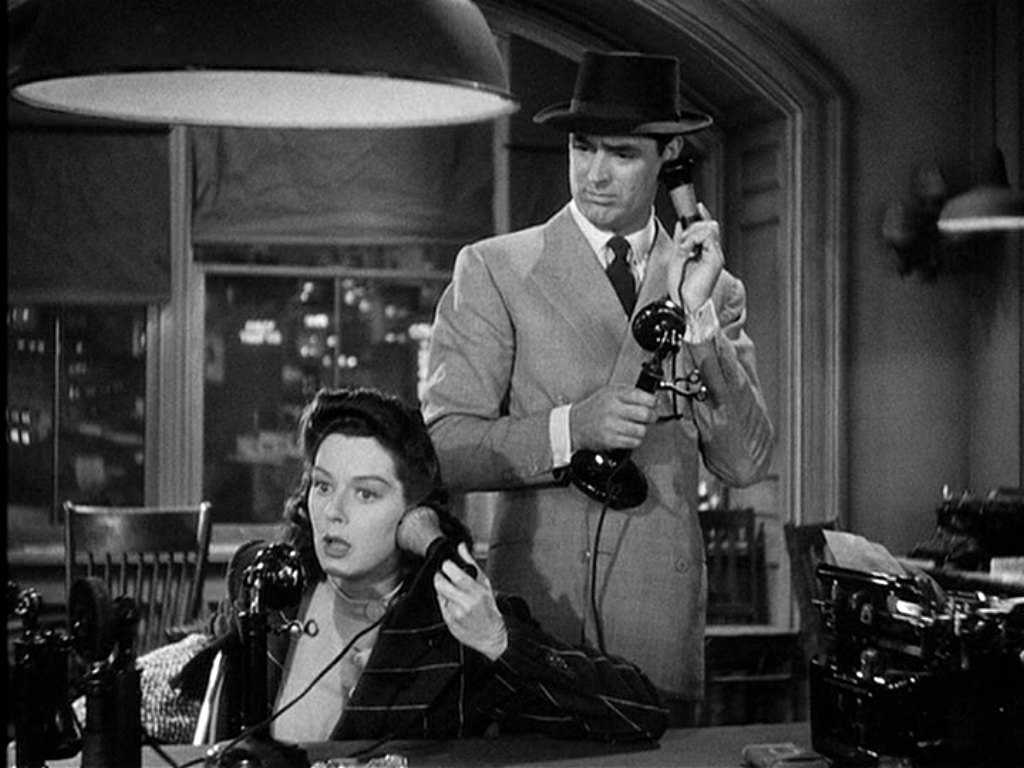
Half the original script was changed, and Hawks encouraged his actors to improvise and ad lib. Apparently Rosalind Russell hired her own scriptwriter to fill out her lines so she could match the size of Cary Grant's part. It was a good-natured battle off and on the screen. And although Russell's character fantasizes about settling down and becoming an obedient wife with a dopey husband, she can't resist the pull of the press room. It's a strange vision of an independent woman with a successful career, who nevertheless loses the war of words with Grant's shyster of an editor. Unlike her namesake in As You Like It, who has her man firmly under her spell, Hawks doesn't allow his leading lady to get the upper hand. The natural state of affairs is for the boss and husband to keep running the show.
Showing posts with label Howard Hawks. Show all posts
2.1.19
1.1.19
The Big Sleep
Howard Hawks prided himself on being a 'straightforward' director, but as David Thomson notes The Big Sleep isn't a straightforward adaptation of Raymond Chandler's murky noir masterpiece at all. The trailer for the film has Lauren Bacall recommend the novel to Humphrey Bogart in a public library, and goes on to preview their romantic scenes, before acknowledging that yes there will be some snooping and shooting as well. Chandler's thriller is hijacked by Hawks and his two stars, who turn it into a love story – with the added frisson that the stars were already sleeping with each other.
So the labyrinthine plot, already difficult to follow in the book, is transposed without the effort to simplify or explain it. It doesn't matter really, it's just a pretext to throw Bogart into scene after scene in which he gets to flirt outrageously with every woman who crosses his eye-line. Bacall is only one of several options who fall for him immediately and inexplicably – the most baffling being a bookseller who closes her shop in order to take a drink and maybe a tumble with Ol' Bogie. That in itself is a strange reversal of standard noir tropes. Usually it's the femme fatale that has the men turning heads and serving her every whim. Here it's a guy that has all the ladies eating out of his hand. And it's all the weirder that he's pushing 40 and is no one's idea of a conventional hunk.
Even with the lascivious horse-racing metaphors, the film is less edgy than it looks. Bogart's character in Casablanca – supposedly a feel-good picture – is actually much darker, the heroism compromised by an environment in which men extort love from women in order to smuggle them to safety. Bacall's duplicity in The Big Sleep never feels dangerous because you know already that Bogart will put her in his pocket. The fact is established in a bizarre scene in which the pair improvise a prank call to the police. The two are already telepathic inseparable love-birds. It's cute, maybe, but it drains the tension and blasts the grit right out of the film.
Subscribe to:
Posts (Atom)

