2.4.17

Exotica

One long striptease of a film, except what is being revealed isn't alluring at all. These clubs are wells of loneliness, and Exotica is about putting that pain and neurosis on display. The film begins with the command to observe people closely – this is a customs official at an airport instructing a newbie, but the lesson is actually for the audience. We are here to ferret out what the characters we meet are hiding.

The task is complicated by the fact that all of them are friendless – some are dealing with loss, others have never been able to adjust to society. And so conversation is inevitably guarded and stilted. In the most explicit description of this unmoored kind of existence, a character talks about a constant state of tension between himself and others. He doesn't try to overcome it anymore. It's just something you get used to and live with.

The film loops in the owner of an exotic petshop who is somewhat peripheral to the slowly unfolding story, but serves to mirror and comment on the proprietors of the stripclub. Both establishments are inherited – the current owners never managing to step out of their parents' shadow. The dancers are associated with exotic animals put up for sale, and the film makes the point that they are for entertainment, not healing. Except the latter is what the characters really need.


Atom Egoyan seems to be interested in the ways people cope with trauma – particularly the idiosyncratic crutches they lean on to process it, even if to the outside observer the behaviour looks strange or deviant. The film seems to suggest that the protagonist doesn't go to the stripclub for a sexual thrill at all – although you can interpret this more unkindly if you so wish. The petshop owner has his own strange way to spend his evenings, and they are mostly for the purposes of hooking up. But the film is asking us to dig a little deeper, and try to accept the way people choose to deal with their problems, even if they seem unsatisfactory at first glance.

There are several layers of meaning in the line "it's a jungle out there" – which gets muttered as one of the characters is leaving the petshop. It underlines a feeling of detachment and alienation from others. But if we are to associate the shop with the nightclub, it also suggests that these places are havens where the hostility of the outside world is tamed. For those that find sex or relationships impossible, Exotica a sanctuary.

I think Egoyan presents all this rather uncritically – he might think that this is where the characters should end up. I'm not sure that's a good lesson to draw, however. The film presents a torturous path to overcoming trauma – one that comes very close to inflicting more hurt and death on people. There is also something about the main character (a white middle class guy) doling out cash to young women in order to work through his issues that feels a bit cringe. The power to weave the fantasy you need to keep going is granted to those who can pay for it, and we get very little insight into the history and desires of the women who provide these services – until the very last moments of the film, that is.

27.3.17

Train to Busan

Working title for which was probably 'Zombies on a Train'. Which may be enough to hang a film on, but this horror flick from Korea is worth a closer look for two reasons. Firstly, the tension is remarkably sustained throughout the running time. After about 20 minutes of set-up, the film is essentially a series of escalating scenarios that winnow down a train's worth of passengers to a handful of survivors. And while the in-world logic comes under some strain towards the end (an unexplained flaming locomotive appears randomly at one point to supercharge the mayhem), there's enough inventive use of the obstacles and opportunities of the setting to keep a thrill-seeker satisfied.


The second reason is that the film is actually about something more than zombies on a train. The protagonist is a fund manager who may share some responsibility for the outbreak. His marriage has failed, and he doesn't spend enough time with his daughter. When the zombies appear, he instructs her to look after number one, and not try to help others. He is contrasted on the one hand with a burly expectant dad who understands that fatherhood is about sacrifice, and on the other with a cowardly small businessman who gets increasingly comfortable with throwing others to the zombies in order to save his own skin. The film keeps coming back to this battle between self-interest and selflessness. At one point, it suggests that there may be a generational aspect to this divide – an older, more community-minded cohort who might still remember the Korean War, and a newer, more individualistic breed of Korean out to work hard, make money and leave others in the dust. It is heavily implied that the zombies are only the next step in that (d)evolution.

But if parenting is about sacrifice, the film places an awful lot of the burden on preserving a happy family on the men. All the female characters in the film are there to be put in peril and subsequently saved by the male characters – even the teenage girl, who doesn't have the excuse of being too young, too old, or pregnant, to fight. The women also don't really have arcs – they either already accept that survival requires selflessness, or are otherwise mindless paranoiacs whipped up into a frenzy by the villain. The only female character who makes a choice in the film chooses suicide in disgust at the moral compromises of her fellow passengers. She kills herself in order to kill others. Only the men kill themselves to preserve their families. Which makes me wonder how far the critique of absent fathers working long hours to support their kids goes.

At one point the burly expectant father boasts that he 'made' the baby growing inside his partner, erasing her role in the process. It's a cute moment, but the joke becomes less funny the more the film valorises his conduct.

18.3.17

Keyhole

My first foray into the works of Guy Maddin – this is a gangsters in a haunted house story loosely based on the Odyssey and preoccupied by the ways your parents mess you up. The Odysseus figure is an authoritarian crime lord who cannot recognise his son, and who is on a mission to gain forgiveness from his estranged wife. The surrealism is justified by the insinuation that all of the action is taking place in the dreams of the son, who is processing his feelings of estrangement from his family. In what is probably the most touching scene, the son demonstrates a machine he has invented which can pass messages to different rooms in the house. He is still a boy trying his hardest keep lines of communication open, and put his family back together. But of course, they're all ghosts in his head. The house is empty.


The film is shot through with streaks of absurdist humour – my favourite being the father's mistress who replies only in (unsubtitled) French. Otherwise, I found the jokes a little bit amateurish, but perhaps you need to be in a certain forgiving mood to enjoy them. More arresting are the slightly coy instances of sexual awakening in the film – not just the son's desire for a beautiful medium he falls in love with, but his fear of the sexuality of other members of his family (the mistress who steals his father away, his mother's father who is always naked and probably gay, and his sister). The film probably adds up to less than the sum of its parts, but there are moments and images that make it worth trying out.

15.3.17

The Love Witch

A film seven years in the making, with the director Anna Biller also taking charge of the writing, editing, set design, wardrobe and props. The care taken over the mise en scène is extraordinary – every bit as impressive as the creations of other detail-driven film-makers like Terry Gilliam or Tim Burton. Biller's world-building makes very few concessions to reality, up to and including the eye-popping Technicolour and stilted acting – a nod to films of the 50s and earlier. But is this visual feast meant to please, or unsettle?

I was getting mixed messages. On the one hand, Biller seems to want to provide female viewers with the enjoyment of watching their fantasies on screen – cute clothes, dashing men, driving red convertibles across California. On the other hand, the OTT girlishness is difficult to take seriously, or at face value. You're not supposed to buy into it in the way you do with Baz Luhrmann or Sex and the City. It's all a bit too fake, too clumsy.

That audience distancing is to the film's purpose, which is to comment on and undercut the world-view of the main character, who is basically a Lana Del Ray figure with a propensity to murder. Elaine is a witch who uses spells to make men fall obsessively in love with her – although the rituals are only the half of it. Most of her allure is down to her willingness to transform herself into a compliant and available male fantasy.


Biller has done her research on assorted pagan and wicca subcultures, but her portrayal of this religion is not flattering. The coven in the film is led by a man, who is basically a creep. He delivers a long lecture on the power of female sexuality to two young girls, who end up dancing provocatively for the enjoyment of old men in a burlesque club. He also gropes Elaine, and there are hints that he used his status as the head of a cult to sexually harass or even rape her in the past. It's therefore difficult to take his advocacy of female empowerment seriously. Biller elsewhere has made the argument that the sexual revolution of the 1960s was incomplete – women may be freer to express their sexuality, but the form and purpose of that expression is still shaped by men. 

Elaine's preoccupation with having men adore her is insatiable. There is an emptiness at her core which requires the constant approval and love of other people. As well as the possible rape by the creepy warlock, Biller reveals that Elaine was (at least verbally) abused by her father. Throughout her life, she has faced demands to be desirable, and seems to have been punished when she is not. Her 'sex magic' is a way to reassert herself using the only thing she has been told she has of value. There is no glory or satisfaction in it. Biller's femme fatale is just an object that stabs back.

5.3.17

Funeral Parade of Roses

Although Toshio Matsumoto acknowledges that an interest in the Oedipus story is what gives this film its shape, he also says the primary motivation for making it was to document Tokyo's emerging gay subculture. And so the plot is constantly interspersed with documentary – including interviews with the actors about the motivation of their characters. Those interviews are sometimes rather uncomfortable to watch – calling to mind Foucault's idea that the demand to disclose your feelings is in its own way oppressive. The questions are often accusatory (what about getting married? don't you like women as well?) and the subjects answer or evade them with as much dignity as they can muster.

It's often quite a fun film – Matsumoto is keen to exploit every cinematic trick he can think of, so there's slapstick routines (mostly absurd catfights), wild psychedelic parties, free love, drugs and (rather violent) student politics. The film employs a cut-up technique, short scenes scrambled together, and sometimes revisited. The effect is to present a kaleidoscope of gay life, building up a sense of a particular place and culture, rather than sticking to a certain character or narrative.


That said, the director's use of the Oedipus story provides a (rather artificial) backbone to the film. By having to follow in Oedipus's footsteps, the protagonist is given a dark past and a doomed future – which casts a pall over the fun and games. The film seems to suggest that these characters are running away from broken families, and are all destined for early deaths. Matsumoto is too fascinated by the counterculture he is filming to condemn it, but the logic of the story he is telling means the film cannot be celebratory either.

Why Oedipus is so interesting to Matsumoto is unclear. Perhaps the transgressive nature of the tragedy serves to underscore the transgressiveness of queer sexuality, particularly in the 1960s, and particularly in Japan. To transgress means to offend propriety, and live with the shame of not being able to conform. The film ends with the protagonist being stared at by a circle of random people on the street, the outrage of the incest melding with the outrage of a nonconformist lifestyle. There's no way around that sort of Greek tragedy, even if one hopes that the subculture the film explores continues to grow and thrive.

4.3.17

Ice

A post-apocalyptic anime film with a premise similar to Children of Men, but with a curious gender twist – only male babies stop being born. In the all-female society that emerges in the ruins of Tokyo, masculinity is associated with militarism and the hubris of science – the two forces that led to the unspecified natural disaster or war that has transformed the planet. Soldiers demure from using handguns, which are perceived as dangerously 'male' weapons.

On the one hand, charges of essentialism are avoided by having a villain tempted by the same 'masculine' forces her society abhors – Julia wants to use abandoned technology to remake the world again. On the other hand, both Juila and the hero Hitomi are presented as very masculine women – in terms of wardrobe, hairstyles and voice. Hitomi is much like other brooding, self-sufficient, celibate male protagonists in anime, and Julia is much like other decadent and depraved male antagonists. The 'female' female characters in the film are invariably of lower rank, less skilled, and have fewer opportunities to display any kind of agency.


The film's environmental message is rather heavy-handed. A memorable instance of body horror is used to disparage the idea of genetic engineering. There is also the rather strange conceit of Hitomi being haunted by the spirit of a girl from 'our' pre-apocalyptic world, who wakes up at the end convinced to change her polluting ways.

It is a rather weird concoction – as with a lot of anime, the plot zips along and compresses a huge amount of information at the start. The overload means you spend much of the film befuddled and unsure of why things are happening. But as a vehicle for extravagant, surreal images of the future, it's rather effective. There are some quite beautiful visual sequences in the film, not least the strange scene of birds transforming into plants and trees. At points you get that sense of future shock from seeing a completely alien civilisation comparable to something like Frank Herbert's Dune. That makes it worth seeing, despite the questionable gender politics.

11.2.17

Chunking Express

This feels like a minor film compared to In The Mood For Love or Ashes of Time. It's set in the present day, and while Wong Kar-Wai is still obsessed by the lovelorn stoicism of his characters, at least here he gives one budding couple an escape.

It's still a bit of a mess though, and I'm not just talking about the long exposure effect Kar-Wai likes to use for his chase scenes. The film is actually two separate films clumsily jammed together, with a takeaway outlet in Hong Kong's Chungking Mansions serving as the bridge between them. Both don't really have enough to them. They are like short stories – vignettes designed to introduce you to a shared setting. And the first is particularly ludicrous, involving a drug dealer gunning down a bunch of double-crossing Indian migrants.


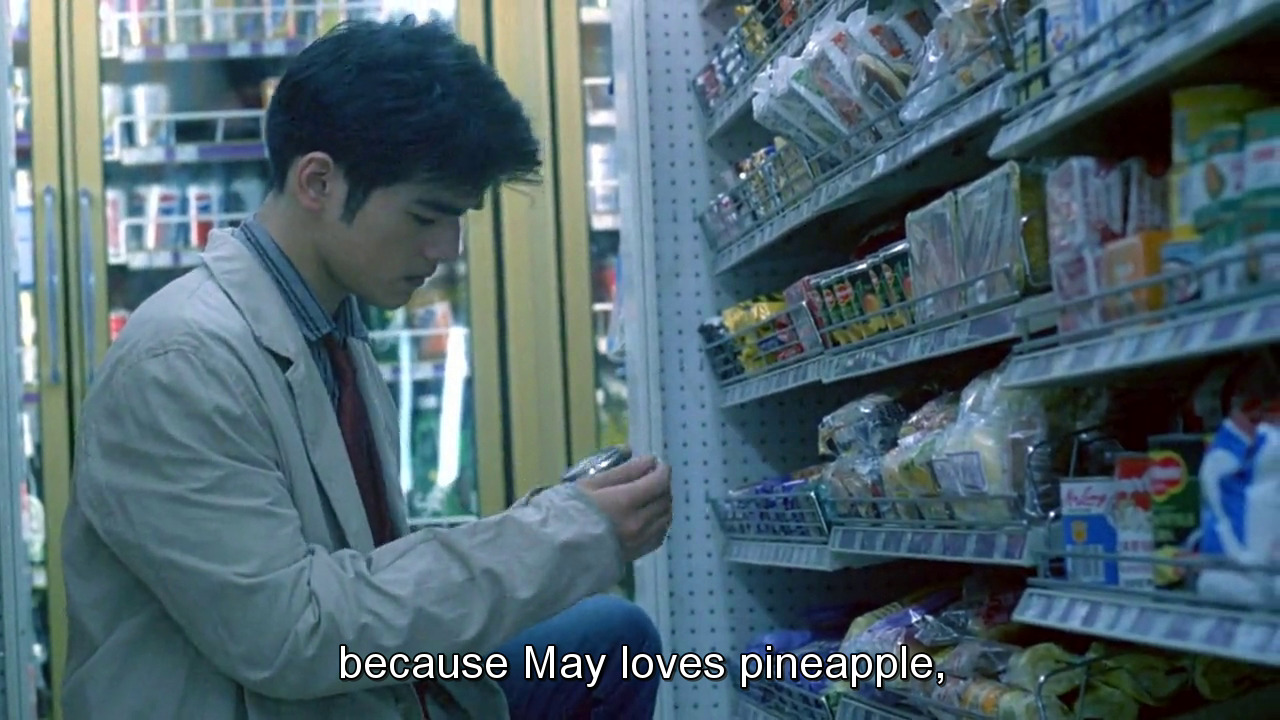
All the characters in Chunking Express feel one-dimensional, defined by quirks like a fixation on tinned pineapples or the song 'California Dreamin' by The Mamas & the Papas. These serve as obvious symbols for loneliness or wanderlust, and they create recurring patterns which fail to build to anything beyond the sum of the parts.

The plot is as contrived as anything else by Wong Kar-Wai – every one of his films I've seen tries to stretch out the possibility of a connection between lovers past endurance. Depending on your tastes, this might be a good thing or a bad thing. I find it unappealingly manipulative when the achingly cool characters involved are so completely devoid of personality.

5.2.17

Trans-Europ-Express

One of the reasons I loved Alain Robbe-Grillet's Successive Slidings of Pleasure was that beneath the weird random imagery it had a sly sense of humor. That delight in the absurd shines through a lot clearer in Trans-Europ-Express – which is essentially a parody of Hitchcockian thrillers. There are several sketches and exchanges which are really quite funny – often almost childishly so.

The film could have done with a bit more of that, and a bit less of the protagonist wandering around the city or the train or pacing his room. But you can't blame Robbe-Grillet for wanting to film great images of Antwerp's Grand Central Station or the city's docks. Nor can you stop him from inserting three scenes exploring the protagonist's deviant sexuality. While noir usually keeps heroes chaste and reserves perversity for villains – here the hero is entrapped and destroyed by lust. Detective stories are usually rather formulaic affairs, but here the plot gets chewed up and mangled by the presence of desire.


While it's enjoyable to watch Robbe-Grillet improvise a film off the cuff and be constantly undercut by the script girl (played by his wife), the film within a film conceit feels less fresh than it perhaps would have done in the 1960s. The overt reminders that you are watching something made up doesn't feel that radical any more. Successive Slidings of Pleasure basically uses the same effect without calling attention to it, and that subtlety makes it a more surprising and provoking film.

2.2.17

The Gap Between Panels / Finding a role

Latest column on the London Graphic Novel Network spoils the shit out of Fumio Obata's Just So Happens – whose main character shares some uncanny similarities with my partner (even down to the name). The book is a critique of ossified Japanese social norms, but it also recognises that it's impossible to completely step outside of society and define yourself without reference to other people's expectations of what you should be. Title of the piece an oblique reference to Dean Acheson's famous quote about Britain, and this book I haven't read. Read it here.