26.7.20

Fallout 2

A post-nuclear role-playing game, although it's not so much about the nasty, brutish and short life you live when civilisation is stripped away, as it is about the myriad ways civilisation can be reconstructed from the rubble. The game has a classic science fiction feel, in that it contains thought experiments about the alternative social and political structures that can emerge when the slate is wiped clean. The fun of the game is in how your choices impact the history of these different places. Your actions literally determine whether a town thrives or dies.

The best example is Vault City – which is the first big urban hub you come across. Its design is clearly inspired by the Athens of classical Greece. It's a democracy in the ancient rather than the modern sense, where citizens have an active role in government, but citizenship is tightly circumscribed (in the game the 'citizenship test' is almost impossible to pass), and there is a large slave population that have no rights whatsoever. Athenian democracy had a very well-developed sense of its own superiority, which the game embodies in the character of First Citizen Joanne Lynette, who quickly becomes hostile if you disparage Vault City's institutions. The city's distinctiveness is reinforced by a strongly held prejudice against the barbarians beyond its walls, who are perceived as sub-human. Through your actions, you can try to establish trading relationships with a neighbouring town populated by irradiated "ghouls", but you run the risk of empowering the city to expand and enslave the surrounding area, much like the armies of ancient Athens would do.


Other parts of Fallout 2 reference other bits of history. The mining town of Redding is caught between the lawless casino capital New Reno and the bland but stable New California Republic to the east. This is where the game gets closest to the western genre. You can swing the balance in favour of one or the other, and while the NCR may appear to be the better option, the game counter-weighs that by evoking a sense of the freedoms of the wild west. New Reno may pump the town full of drugs, but it has no police force, and in the clash of competing crime families a degree of independence can be maintained. It's a choice between the chaotic and lawful spectrum of the Dungeons & Dragons alignment system – anarchism with all its dangers and liberties versus a safe but restricted life under the rule of law.

The game is sprawling not only geographically but tonally – mixing together poverty, drug addiction and prostitution alongside crass schoolboy humour, pop culture references and in-jokes. Different designers were responsible for different areas, which explains some of the inconsistencies. The game also had a tough deadline, which meant that a lot of areas have an unfinished feel, particularly the final city San Fransisco, which is full of empty containers and has an entire map of the docks with no content whatsoever. There are some irritating bugs as well, most notably with some of the endings, which didn't marry up to the decisions I made in the game itself.


The biggest problem with the game, however, is that the central narrative is weak, and doesn't provide enough motivation to push you through to the next area. The mystery of the Enclave isn't revealed until the very end of the game, and a lot of the time you are left wondering what to do and where to go next, with only the enticement of exploring a new area to keep you interested. Despite some attempts to interweave quests between cities, the game remains quite modular, and at several points I was tempted to drop off once I had completed the quests in a particular region. The main campaign in Baldur's Gate – a CRPG from the same era and studio – introduces the outlines of its conspiracy from the very start and is therefore much better at hooking you into the narrative. 

The Enclave itself presents a simple inversion, turning the remnants of the US government into a fascist secret society that has developed genocidal tendencies. The diverse cultures that have bubbled up on the west coast are perceived as irredeemably irradiated or mutated and therefore to be purged by an airborne virus to create living space for the only 'real' humans left on the planet. Not many games lead you to assassinate the President of the United States, but in doing so, you defend the rich variety emerging out of the wreckage of the apocalypse against the regime that caused it. But the game is subtle enough to include wrinkles in that victory – as factions like the Shi, NCR and Vault City have their own totalitarian tendencies.


Fallout 2's role-playing and combat systems are complex but robust, and there are few ways to break your build. That said, some skills and perks are definitely better than others, and as I wanted a relatively painless experience, I relied on a guide to get the most out of the game. There is a bewildering variety of weapons and ammo available, and the details of how armour works remained somewhat mysterious to me. That said, combat is very fun, particularly when you are at the very edge of being able to survive encounters, as I was when I faced the geckos in the Toxic Caves and the xenomorphs in the Redding mines. Money and experience pile up to ridiculous heights, and it was very satisfying to be able to mow down enemies that had previously given me nightmares with my endgame equipment. UX is awful, particularly the inventory, but you get used to it. Party NPCs are outside your direct control – which can lead to them doing ridiculous and infuriating things, but you can fiddle with their AI to get better results, so all-in-all the game is still very playable, and worth persevering with. Few RPGs give you so much scope to affect the world created around you.

6.7.20

Beetlejuice

The original script was much darker, and traces remain underneath the finished product's goofy slapstick. Keaton's Betelgeuse is a perv as well as a prankster – harassing Geena Davies at every opportunity and setting his sights on hooking up with an unwilling Winona Ryder, who is just a child. So lurking behind the cartoonish wedding ceremony, which provides the final moments of tension in the film, is the spectre of sexual violence and paedophilia.


That makes the film quite strange tonally. For the most part, it looks like Caspar the Friendly Ghost given the Tim Burton design treatment. Alec Baldwin and Geena Davis are wholesome, unadventurous nerds happiest when at home in their rural townhouse. The Deetz family are absurd caricatures of metropolitan bourgeois values, while their daughter is the most ridiculous goth on screen. There are little shadings of tragedy underneath the fairytale portrayal though. Baldwin and Davis's domestic bliss is marred by their inability to have children. Ryder finds her parents repulsive and considers suicide as a way to escape their clutches and join Baldwin and Davis in the afterlife.


If the film is about anything, it's about Ryder finding happiness in a surrogate all-American family structure that leaves her real parents compartmentalised in the attic – free of the responsibility of trying to understand or look after their daughter. In their way, they also find contentment – Charles finally escapes the rat race, and Delia pursues her hideous art projects as a form of private expression (much like Baldwin and his model-building). Betelgeuse is a degenerate wastrel completely alien to the small town middle class community Baldwin and Davis belong to, and the Deetz family join by rejecting their urban attachments and attitudes. While Burton's design sensibilities are outlandish and bizarre, his film is ultimately a tribute to conformism – championing the containment and domestication of deviant urges so that family and society are preserved.

19.6.20

Lady Bird

The intention behind the film was to make the equivalent of a Boyhood-style coming-of-age movie, but from a female perspective. Thankfully it doesn't stretch into three hours but is quite tightly edited. Scenes are like snapshots, with hard cuts moving you drastically forward in time before you can linger on how a moment develops or resolves. That makes for some discordant effects – Lady Bird and her mother are screaming at each other in one scene and then back on speaking terms the next. But I think that's to the film's purpose, which is to highlight the complexity of their relationship. This is encapsulated by an exchange towards the end of the film where Lady Bird gets her mother to admit that while she may love her daughter, she doesn't necessarily like her.


Although the film has an unvarnished style (Saoirse Ronan didn't want to cover up her acne with makeup, for example), there are still references to genre staples, although they are given a twist. There's the slightly less conventionally attractive best friend, but in one of the sweet moment in the film she becomes the prom date rather than the entitled, pretty dude in a band. And the traditional race for your love trope in an airport is not romantic but involves the mother realising that she wants to have a proper goodbye with her daughter, and it doesn't resolve as it normally would. These subversions show that real life isn't as neat and tidy as films make out, even if you sometimes need to use filmic short cuts to communicate meaning and emotion.


It's very good – and reminded me of stupid things I did when I was in school. It's a Bildungsroman in the style of A Portrait of the Artist as a Young Man, where flight is necessary in order to develop as a creative and as a person, but that distance reinforces the impact of the place where you grew up. Joyce never stopped writing about Dublin even though all of his books were written in mainland Europe. Greta Gerwig seems to have the same conflicted feelings about Sacramento. In another pivotal scene, the ability to really observe her surroundings is reinterpreted as a kind of love. That applies as much to the mother-daughter relationship as it does to the city.

12.6.20

Vampire: The Masquerade – Bloodlines

The cruel trick Bloodlines pulls is to make the thing you are pursuing, built up like the Ark in Raiders, into a meaningless McGuffin. Your boss doesn’t use his wealth and influence to achieve anything substantial but just has you chasing baubles. The most satisfying ending is therefore seeing how his dreams of world domination are subverted and destroyed, leading to the triumph of the Anarchs – a sect with barely any political organisation championing the dispersal of power.


Although you become a formidable vampire by the end, you are always a pawn, as some of your more mysterious emails testify. The chessmaster knows all the moves before the game starts, and the beginning tutorial with Smiling Jack takes on a new significance with that hindsight. The implication is that without his guidance you wouldn’t have made it out of Santa Monica, but he trains you up to be the perfect sleeper agent – one who doesn’t even know who is pulling the strings. And if you decide to become a prince yourself, you end up sharing the fate of your erstwhile employer. The game tempts you with power and punishes you if you seize it. 

It’s an interesting move to have the game telegraph the player’s lack of agency in this way. At the very beginning, a fortune-teller basically tells you what is going to happen, and if you play as a Malkavian (a vampire who sees the future at the cost of going mad) you get voices in your head revealing upcoming events. RPGs are supposed to be about player choice, but Bloodlines is acutely aware of the limits of that, not just in the game itself but in the format generally. You are never as free as you might wish. At some point, the game will find a way to railroad you to where you need to go. Bloodlines hangs a lantern on that manipulation. You are a puppet of the other characters in the game, and ultimately of the developers who made it.


It’s a vampire game, so it’s very sexy. But it’s also a noir set in LA, so the sex is sordid and gross, and the developers don’t quite distance themselves from the exploitative and objectifying nature of what they are portraying. The most glaring example of this is the cheat code for inflating the breasts of female character models to ludicrous proportions, but even without enabling the console, you have the optional fetch quests which reward you with nothing but risqué posters of the female characters in the game, literally reducing their complexity to two dimensions.

While you do spend a lot of time in porn shops and peep shows, and can observe blow jobs in alleys and lap dances in strip clubs, as a vampire you are nonetheless cut off from participating in the game’s sexual economy, at least in the normal 'human' way. Vampire society finds sex distasteful and vampires who have sex are perceived as degenerates. So although you can seduce girls in clubs or pay hookers, it’s not their bodies you get, but their blood. That has an interesting distancing effect from the seediness all around you. You move in a world where sex is available everywhere but for you it's mediated by a need to fuel your vampiric powers. In most playthroughs, you don't actually get to sleep with anyone. You are a bloodsucker, not a sybarite. You’re there to use people, not enjoy them.


Sexuality in Bloodlines is structured by the heterosexual male gaze and caters to the whims of the perceived audience for the game. But while the female characters may be designed with fan service in mind, the writing is strong enough to make them interesting nonetheless. A minor example is Velvet Velour, who may embody the stripper-with-a-heart-of-gold stereotype, but who is also very aware of how she is perceived and patronised by the people around her. If the player completes her side quests she will start emailing you bad romantic poetry, but in doing so she also comments on how her creativity might be dismissed because she is (or at least used to be) a sex-worker.

Therese and Jeanette are more complex, and this piece by Cara Ellison is a good articulation of how they represent the Madonna-whore complex, and how society rewards one and punishes the other. Even then, the game is quite clever in subverting this dynamic – showing that Jeanette’s voraciousness is ultimately a healthier expression of sexuality than her sister’s, which is the product of patriarchy in a really quite dark and disturbing way. The player can pick which character to save, or they can save both, in which case the sisters learn to manipulate their contrasting images and gain a new kind of interiority beneath the masks they wear. That outcome underlines the impossibility of building a self outside of the expectations of the world around you. The only freedom to be found is in understanding and mastering the roles you have learned, and discovering how to slip between them.


A still more fraught moral dilemma is presented by the fate of Heather Poe. Arguably the game fridges her to provide some extra motivation in taking down the Sabbat, but you could also read this as a way to actively punish the player for engaging in what is clearly a toxic relationship. Heather is your ghoul – a human dependent on your blood – and she becomes emotionally obsessed with you even if you treat her like dirt. The ickiest expression of her submissiveness is how the player (in another blatant bit of fan service) can tell her to change her outfits, either into to something "dark and gothy" or into her underwear. The ethical thing to do is to release Heather from her blood bond, not only because it removes her from danger but because it allows her to escape an unhealthy relationship that can easily turn into an abusive one. The twist is that mechanically the game rewards you for keeping her around – she drops out of college and gives you her money, she's a dependable source of blood, and finally just before her death she'll get you the best armour in the game. It's like you are being given a perfect girlfriend that gives you presents and does everything you say, but the game will kill her if you don't do the right thing and let her go to become her own person.


The writing and the characters are Bloodlines's strong suits. There are problems with the gameplay that are only partially addressed by the decades-long fan community project of fixing the game's bugs. Although missions were intended to allow for different playstyles (combat, stealth, social skills), in fact the game guides you towards using stealth in the middle portion of the game and combat at the end, and if your build isn't versatile you will struggle. I rolled as a gunslinging Toreador and found the majority of the game pretty well-balanced. I even had fun shooting my way through the Sabbat stronghold, although other players tend to experience it as a grind. Having the flamethrower made the fight with Andrei trivial (and enjoyably so) but the other boss fights were too much for me and I ended up partially cheating my way through them. Ming Xiao has far too much health, making the fight a tedious war of attrition, and the final fight on the rooftop had too many things going on at the same time for me to really try and engage with it. That said, given its reputation I found the game a lot more playable than I expected. Only the very final couple of missions were troublesome.


The game does better when it comes to environmental design. There is a justly famous haunted house level early on which remains a masterclass in how a game can freak you out – all the more impressive in that the ghost can't actually hurt you very much. A later level in what is effectively a private insane asylum also does a good job in building mood, while also serving as a character study for one of the vampire barons that you never actually end up meeting (the sound design for the level also purposefully drives you a little bit unhinged). The developers licenced an early version of Valve's Source engine to make the game, and it all still looks pretty great. The decision wasn't so much about taking advantage of the engine's physics as it was about utilising its unbeatable facial animation, which alongside some solid voice-acting makes a typical pitfall of action RPGs into a strength. The visuals are there to make interacting with the characters as immersive as possible. Those characters are ultimately what makes Bloodlines such a joy.

29.5.20

Water Lilies

Céline Sciamma's debut is shot in a minimalist, realist style, but there are occasional flourishes which reveal the influence of David Lynch. At the party at the end of the film, the boys from the swimming team have their trunks on their heads and are rowdily jumping around in slow motion. They are dehumanised – the film treating them as equivalent to a brood of xenomorphs on the prowl for female flesh. Meanwhile, the beautiful Floriane dances provocatively trying to grab their attention. Her beauty means she is constantly harassed by men, and she has been conditioned to accept her fate and respond to their advances, although she doesn't actually want to sleep with any of them. Both Floriane and the boy François (the mirrored names feel significant) end up using two younger girls for their own sexual purposes. Their influence is ultimately toxic, and the film reads like a warning against becoming a victim of your own adolescent sexual desires.


Events revolve around the swimming pool, where Floriane is the captain of a synchronised swimming team. The sport is physically demanding and the routines are impressive, but there is a rigidity to the beauty ideals it embodies. It requires a lot of work and a lot of make-up. The film closes with the two younger girls rekindling their friendship in the pool – they jump in with their clothes on and float peacefully together, revealing the film's title to be a metaphor for that end-state. The swimming pool becomes not a site of conquest and competition, but serenity and companionship away from the predatory nature of patriarchal heterosexual society.

22.5.20

Election

What is the motivation behind Jim McAllister's resentment of Tracy Flick? Surely a civics teacher would be delighted that one of his students takes such an interest in his subject, and is so driven to succeed. The answer isn't as simple as it might appear. Jim's own explanation is that Flick ruthlessness needs to be countered otherwise her life will be spent crushing the voices of the people around her, although that's based on a partial and unfair view of Flick's affair with his friend and colleague – which destroyed his career and marriage. The irony (in a film full of ironies) is that McAllister's intervention against Flick destroys his own career as well (his marriage he manages to destroy himself).


So there's something else going on as well – the resentment of a mentor who can see that his charge will go on to far greater success than he managed. He's just a civics teacher, but Flick will end up being a politician for real. McAllister might try to comfort himself with the notion that his life is ultimately more rewarding, even after he's lost his job and has to move to New York, but that's just cover for the envy he must feel.

And there is definitely a gendered quality to this antagonism as well, which the film brings out in its darkest moments. McAllister doesn't actually understand women – not his wife, nor the woman he tries to have an affair with. His best friend has related his sexual experiences with Flick, and she becomes sexualised by him as a result – drawn out by the fact that his first move against her is inspired by a porno film, and her face keeps popping into his mind when he's having sex. McAllister's irritation may be that he's not used to "uppity women" telling him what to do, and working with Student Council President Flick for a year presents a sufficient challenge to his authority for him to want to avoid it. But the film suggests that these feelings are curdled by a deeper annoyance that this powerful woman is not sexually available to him.


Although Election is supposed to reflect and satirise in microcosm the American political system, the parallels only go so far. The fundamental tension of politics between the rule of the specialised few and the rule of the many, and the way our system of representative government comes to an uneasy accommodation between the two, is only hinted at in McAllister's lecture about the importance of political choice. Tammy's kamikaze run at the presidency may be a nod to the attractions and dangers of political populism – she is right that in some sense the system prevents genuine change, but her (wildly popular) solution to dissolve the meagre democratic elements of that system would just make the problem worse. These are asides in a film ultimately more interested in dissecting the ways men can have mid-life crises, and drawing out the grim comedy inherent in such situations. It's a subject that becomes a through-line in Alexander Payne's work, and unfortunately it's not one I'm particularly interested in.

The film makes liberal use of voiceover to highlight the characters' feelings, and also their inability to fully understand themselves. It's probably just personal preference, but I do find that the way the technique is deployed tends to trivialise its subjects, reducing them to caricatures. The depths in the film are revealed through the characters' actions and interactions, and gaining access to their thoughts paradoxically puts us at a distance from them. We are given the opportunity to rise above the events we are watching, and feel a smug satisfaction in observing these strange, unsatisfied people and what they get up to. The more confrontational approach would be to eliminate such avenues of escape, so we are truly in the moment when McAllister or Flick lose their minds.

14.5.20

Planescape: Torment

This is a very strange game, in that so much of the stuff that's memorable and even moving about it is pretty much extraeneous to its mechanics. You can 'play' Torment badly as a typical CRPG where you kill things for cash and experience, but you would miss maybe 90% of the content, which is in the reams and reams of text you read. Even then, the 'conversation battles' that you have (which tend to be a more effective way to gain XP and levels anyway) are not actually the highlights for me. Instead it's the descriptions of certain key memories you unlock, all of which are optional extras there to fill out the story.

In another game these memories would be conveyed visually through cutscenes. In Torment you read about them as you would a novel – your dialogue options stripped away to just continuing or stopping. They are chunky intrusions into the gaming experience, and normally when a visual medium does this it is an irritant (particuarly noticable and egregious in comics). But here it becomes a test case for the power of the written word in evoking character and emotion. 


Three memories in particular stand out for me. They are all examples of a previous incarnation of you (the 'practical' one – although that's quite a polite way of decribing what is actually a highly-functioning sociopath) tormenting other NPCs in the game. The justly-acclaimed sensory stone 'experience' with Deionarra is the most ambitious, in that it's told from three angles simultaneously – with the account diving into Deionarra own feelings of heartfelt devotion, then switching to your previous incarnation's heartless manipulation of her, and adding your present day reaction to the unfolding events, which heightens the sense of stakes in what to a completely external observer would be a rather unremarkable exchange between two potential lovers. The dramatic tension is created by the contrast between what is in these characters' heads, and the knowledge that Deionarra's small-scale decision to accompany this man has proved fatal.

The other two memories both involve this previous incarnation physically abusing two NPCs that you can recruit into your party – Ignus and Morte. In a game where you can slaughter scores of low-level criminals without much thought beyond how irksome it is that they keep attacking you, it is another testament to how words can bring out the reality of violence so much more powerfully than visuals. It is in the specific descriptions of flesh burning and bones cracking, the sounds and smells that are evoked, which underscore how cruel your previous incarnation was, and how much you have to atone for his crimes.


This would be really great writing anywhere, but in the context of what is ultimately another Dungeons & Dragons CRPG made in the Infinity Engine it is particularly novel and striking. Sometimes you do need a lot of words to bring out the detail of the interactions between characters, and perhaps it's not possible to get to the depth of characterisation Torment achieves without that wordcount.

So maybe it's fair that detractors of the game suggest that it would really work better as a novel. There is no player choice in those three memories. It's just flavour of a particularly bitter kind – underlining just how much of a shit you used to be. Actually, the Enhanced Edition comes with a novelisation when you buy it on GOG, but it's telling that I haven't really been tempted to read it. Although player choice isn't a feature of the game's emotional highpoints, it is still a significant part of the conversations and decisions you make when playing, to the point where having a single definitive version of events doesn't feel like it will capture the richness of the game itself.

If the above sounds like I'm downgrading the importance of visuals in telling Torment's story, I don't actually think that's the case. It's just that Torment employs them in the right way – realising the fantastic world that provides the backround to these small but poignant character moments. This is actually a better-looking game than its Infinity Engine precursor Baldur's Gate, but in both games the visualisations of the characters isn't the main draw. Instead, much of the beauty lies in their richly rendered maps and the well-designed soundtrack, which even in Baldur's Gate is full of incidental details that deepen immersion in the world. And while Baldur's Gate is purposefully traditional in scope – aiming to faithfully translate the Tolkienesque Forgotten Realms D&D setting into a computer game, Torment reflects the oddball sensibilities of its Planescape setting, where literally anything is possible if you believe in it hard enough. Sigil is a feast of spiky buildings and spikier inhabitants. The visuals are there to do something that the words will have a hard time doing – which is to easily evoke an environment and atmosphere that is literally otherworldly. Contrast that to the next iteration of CRPGs like Neverwinter Nights and Knights of the Old Republic, which went 3D and put lackluster character animation to the fore, and it's hard not to conclude that the isometric display of the Infinity Engine was the right way to go.


A note on the combat, which gets a bad rap everywhere. Maybe the Enhanced Edition has tweaked the game to make it more balanced, but I generally didn't have a problem with it. By the time I got to the first big dungeon I had two fighters in my party to protect my squishy mage, and they were robust enough for me to face down Many-As-One, which in one of the many inversions of the game makes rats (normally a weak tutorial enemy) into a tough and scary boss fight. The only actively irritating part of the game was the Modron Maze, which is a dungeon designed by computers and is almost purposfully unenjoyable, and I had no qualms about cheating to get myself through it. By the time I got to Curst Prison I was geared up and had unlocked stat boosts for my main fighters, and could use my thief to scout and backstab. So for me it was actually pretty fun to pull enemies out with Morte's taunt ability and chop them up one by one, or mess them up from afar with AOE debuffs. Torment lacks the four-dimensional chess aspect of the magic system in Baldur's Gate II, where preparation, combos and counters can make you feel exceedingly clever in finding the right solution to get through an encounter. But there is still a certain kind of satisfaction in having your specced up party be capable of taking down hordes of beasties in UnderSigil, a totally optional combat dungeon at the end of the game.

Torment scales back the variety of spells, weapons and monsters found in Baldur's Gate. Instead its development resources were spent on its wordcount, which meant delving deeper into a smaller number of companion characters, and fashioning a more intricate and satisfying story. The conceit of the game – an immortal who has lost his memory and must find out who he is – is shaped into a metaphor about facing up to the mistakes you made in the past, and accepting responsibility for them even if they were in some respects committed by a different person. The game keeps circling back to the question of "what can change the nature of a man", but the answer is ultimately individual and not especially relevant. Instead it's the premise of the question that's important – your nature can change. And while that sounds hopeful it does not liberate you from having to deal with the consequences of the actions of your past selves. And for me it's the excellently written memories in the game, which detail the specific personal torments you have inflicted, that really hits that message home.

10.5.20

Chloe

The necessities of the thriller genre demand that Chloe remains a mystery, even after the film ends. It's unfortunate, because like a lot of thrillers the plot hangs together by threads and really the central conceit is ridiculous when you take a step back and think about it. Julianne Moore starts to suspect that her husband Liam Neeson is having an affair, and (very randomly) finds a sex worker played by Amanda Seyfried to try and seduce him in order to prove to herself that he is a serial philanderer. But Chloe turns out to be very capable at seduction, and is ultimately more interested in Julianne Moore than anyone could have guessed.


But why? Egoyan's Exotica proved that the filmmaker has an interest in the strange things broken people do in order to put themselves back together again. And it feels like Chloe is one of these people. We only get inside her head at the beginning of the film, through voiceover, where we're told of her awesome powers of knowing exactly what people want, and giving it to them. What's left is a hole which Chloe seeks to fill by ingratiating herself into the lives of a fabulously successful middle-class family, and tearing them apart.

We know nothing about Chloe's background, but sex work isn't often very glamourous even if you're at the upper end of the market, and I wonder whether her machinations aren't partly motivated by resentment. The film luxuriates in the accumulated capital of the unsuspecting family – they have an ostentatiously-designed house, beautiful furniture, and they spend all of their time in fancy restaurants. This is a film about well-off people having marital problems (the dullest genre of contemporary fiction), but then the added ingredient is someone on the very margins of society looking in and seeing what she doesn't have.


Maybe class envy is a reach too far, although it does make the film's glossy sophistication a tad more bearable. There is instead a throwaway reference Chloe makes to her mother's hairpin, which the film makes symbolically significant. Chloe lied about the hairpin previously, but perhaps the connection with her mother is true, in which case her wish to give it to Julianne Moore may be inspired by a need for a replacement mother, or a route into a family she doesn't have.

The last shot of the film shows that Moore has accepted that gift, even when Chloe is no longer there. Chloe has been turned into a thing, which just highlights that for much of the film that's all she was. But at least that thing now finally starts to have a meaning for Moore. Chloe is no longer just a tool or a vessel for other people's desires, but someone with desires of her own. In the erotic thriller genre, the femme fatale's motives are usually malevolent, but here it's Chloe that's ultimately the most out-of-control and desperate, even if Julianne Moore is the one that looks like her life is falling apart. Accepting the gift is an act of forgiveness, and perhaps also a recognition of Chloe's subjectivity, even if it remains largely elusive to her, and us.

3.5.20

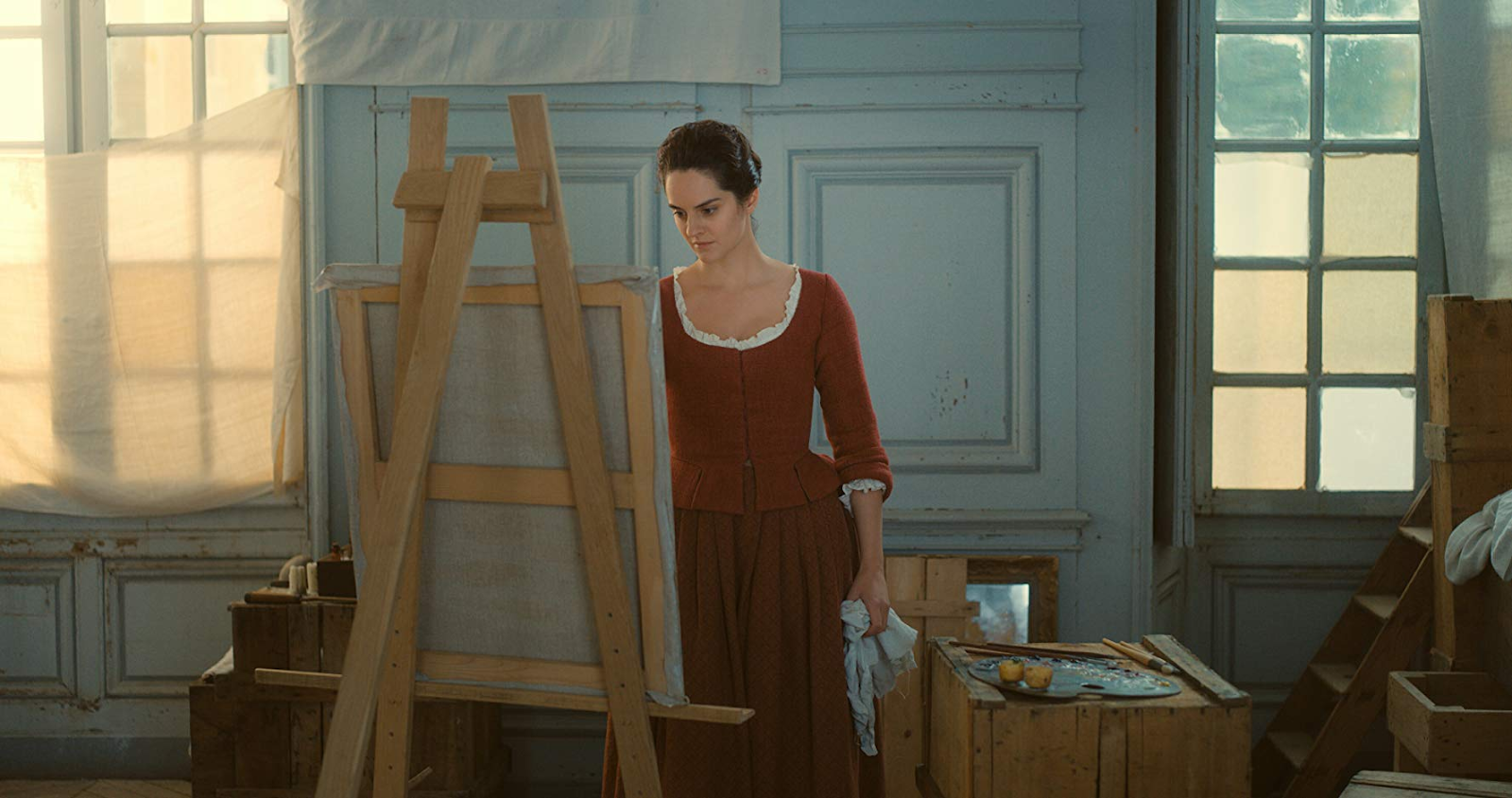
Portrait of a Lady on Fire

From the opening credits a parallel is being set up between the film we are watching and the act of painting. It is about the process of composition as much as it is about the process of falling in love. In the first scene, one of Marianne's students unearths a painting of hers which shares the title of the film. It's a work of art displayed against the artist's will by a proxy for us, the audience. The film is the painting. It's an example of the art that has been buried for expressing something hidden and forbidden, produced without the sanction of the arbiters of moral and aesthetic tastes.


The story starts off like a low-key thriller. Paintings in this society serve as adverts in the patriarchal marriage market, but the male painter couldn’t finish Héloïse's portrait as she refused to sit for him. Héloïse is determined not to be complicit in the creation of art that she has no control over in the same way as she is resisting her mother's attempts to place her in a marriage she has no say over. So her mother asks Marianne to pretend to be a companion, observe her and paint her portrait in secret. The portrait we see at the beginning of the film, which is allegorical rather than representative, cannot serve that purpose. So we know already that this relationship has been the foundation for a more genuine form of art as well as a more genuine kind of romance.

In the various paintings Marianne makes of Héloïse, we see that the latter is teaching the former to abandon the conventions and constraints of the time to arrive at a truer form of self-expression. Love and artistic breakthrough are intertwined. In the final painting in the film we see that Héloïse has managed to assert some control over its creation as well, smuggling in an erotically-charged message to Marianne in what is otherwise a celebration of family values. There is a secret history of art created by women excluded from the canon by their gender, and this film is a celebration of, as well as a participant in, that history.


Sciamma is constantly prodding at the inequities of the past. Héloïse's sister committed suicide, perhaps to avoid her fate of being married off to a man she doesn't know, but that means Héloïse must take her place. Marianne questions the freedom Héloïse found in the convent, but it had a library and music, and she felt she was treated as an equal. Men are almost literally peripheral to the film, appearing taciturn and stony-faced to transport Marianne to the island at the beginning (in a scene heavily redolent of The Piano) and take her away again at the end. There are no men at the fete, and the servant relies solely on the company of women to get an abortion. The father isn't mentioned but is probably the previous painter – a failure as well as a source of obstacles and problems. Héloïse's mother is complicit in the patriarchal system (for understandable reasons – there are always trade-offs in life). She must also be removed for the romance to blossom. The radical implication is that only in supportive women-only spaces are women allowed to love and create freely. A throwaway scene in which Héloïse chops up some giant phallic-looking mushrooms for the stewpot might be the film's final word on this.