Film lexicographer David Thomson sees this is the clearest evidence of Kubrick's "art director's cinema", where narrative is sacrificed on the altar of set design. I think 2001 is far worse in that respect. That film was state of the art and knew it – lovingly lingering over its innovations and making large sections ponderous and boring to this viewer. 2001's narrative is also less satisfying, being simply a series of repeating grandiose developments that obliquely mirror each other, and are too open to interpretation to really mean very much in the final analysis. The structure of A Clockwork Orange has a more satisfying circularity: the protagonist's actions in the first half of the film coming back to bite him in the second.
Anthony Burgess's Catholicism-inflected worries about the suppression of free will by new-fangled techniques of psychological manipulation come through in Kubrick's adaptation, but aren't as interesting now given that the mass use of aversion therapy for political control has not come to pass. In any case, the film isn't particularly interested in the causes of Alex's sociopathy and addiction to "ultraviolence" – something he shares with the majority of the young (male) characters in the film and seems therefore to be at least partly down to wider currents in the culture. It may reflect contemporary concerns that the lifting of social constraints on personal behaviour in the 60s would unleash the very worst in teenagers and lead to the collapse of all moral authority. Certainly Kubrick believed it – pulling his own film from being distributed in the UK after what looked like a copycat murder.
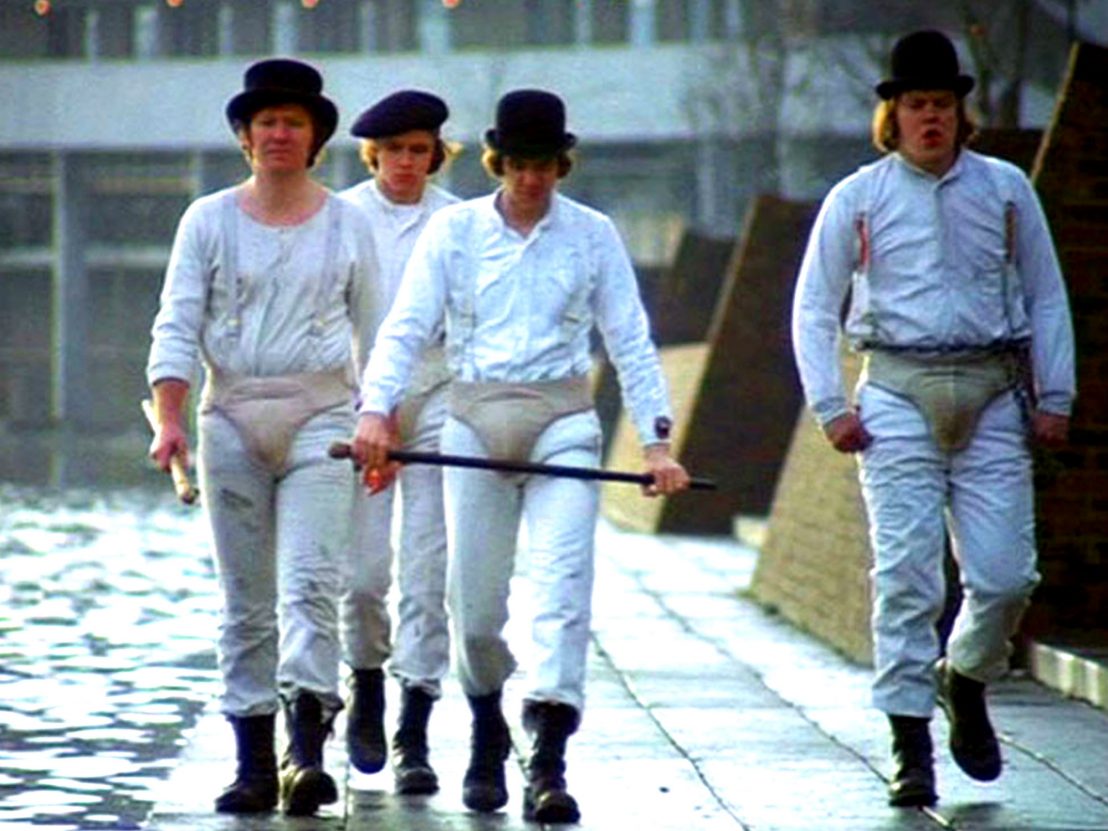
It's hard to conjure that sense of moral panic now, given today's teenagers appear to be more clean-living than their parents used to be at the same age. What's harder to grasp is the film's critique of both reactionary politicians' attempts to clamp down on lawlessness, and the liberal resistance movement who wish to utilise these new techniques of reforming criminals to institute a kind of inward tyranny, where the freedom to choose is eliminated and people are conditioned to be docile and non-violent. Alex is caught up within the conspiracies of these two tendencies, and the final image of the film is one of dark triumph, showing that neither the police nor the psychologists can dampen the antisocial passions raging in the heart of man.
Showing posts with label Stanley Kubrick. Show all posts
13.4.19
17.10.15
The Shining
One of the funniest bits in Vivian Kubrick's making of documentary is the footage of Jack Nicholson riling himself up for the "Here's Johnny!" scene: manically jumping outside the bathroom door, swinging the axe around, chanting "fucking fuck, die, pussy, die!" Subtext becoming text in between takes...
Because what is Jack Torrence if not a pygmy of a man, a failed writer who feels ashamed to work dead-end jobs? Nervy and insecure, he bullies his wife and takes her for granted. There is an internalised rage at his own impotence that only gets worse as his failure to create, or to exert control over his environment, becomes more and more evident. While his wife manages the household and raises their son, he does nothing but gnaw at his own pathetic existence.
There are subtle overlays to this resentment. Jack is induced to reassert control over his family by a posh Englishman. Patriarchy is associated with bourgeois standards of respectability: the husband gains his authority by being employed, his wife and children in turn must be utterly obedient to what he says. Sex and drink outside the family home are further rewards of this status, although Jack has an almost childlike awe and fear of the female body.
A hidden racism is also unearthed. His son forms a connection with a black man who becomes an alternative source of comfort and protection. Such mixing must be ended, say the haughty poshos. This unacknowledged racism also comes through in the fact that the hotel is built over an Indian burial ground. A horror cliche, perhaps, but it does nod to the genocide that accompanied the creation of the United States. The final shot is of Jack becoming one of those sinister poshos in a 1920s photograph of a ball in the hotel, 10 years after the original inhabitants were forcibly (and violently) shoved off the land it was built on. Intersecting forces of class, sex and race underlie Jack's descent into madness.
I'm minded to ascribe most of these nuances to Stephen King rather than Stanley Kubrick, who I have a low opinion of after the tedium of 2001. This is a far better avenue for his fixation on swooping through beautiful sets with wide-angle lenses. The inherently alienating effect this creates is a good match for the chilling distance between Jack and his family. Makes me think David Thomson is probably right to say The Shining is Kubrick's one great film.
Because what is Jack Torrence if not a pygmy of a man, a failed writer who feels ashamed to work dead-end jobs? Nervy and insecure, he bullies his wife and takes her for granted. There is an internalised rage at his own impotence that only gets worse as his failure to create, or to exert control over his environment, becomes more and more evident. While his wife manages the household and raises their son, he does nothing but gnaw at his own pathetic existence.
There are subtle overlays to this resentment. Jack is induced to reassert control over his family by a posh Englishman. Patriarchy is associated with bourgeois standards of respectability: the husband gains his authority by being employed, his wife and children in turn must be utterly obedient to what he says. Sex and drink outside the family home are further rewards of this status, although Jack has an almost childlike awe and fear of the female body.
A hidden racism is also unearthed. His son forms a connection with a black man who becomes an alternative source of comfort and protection. Such mixing must be ended, say the haughty poshos. This unacknowledged racism also comes through in the fact that the hotel is built over an Indian burial ground. A horror cliche, perhaps, but it does nod to the genocide that accompanied the creation of the United States. The final shot is of Jack becoming one of those sinister poshos in a 1920s photograph of a ball in the hotel, 10 years after the original inhabitants were forcibly (and violently) shoved off the land it was built on. Intersecting forces of class, sex and race underlie Jack's descent into madness.
I'm minded to ascribe most of these nuances to Stephen King rather than Stanley Kubrick, who I have a low opinion of after the tedium of 2001. This is a far better avenue for his fixation on swooping through beautiful sets with wide-angle lenses. The inherently alienating effect this creates is a good match for the chilling distance between Jack and his family. Makes me think David Thomson is probably right to say The Shining is Kubrick's one great film.
30.11.14
2001: A Space Odyssey
At the BFI screening I went to, we were provided with the interpretation of a New Jersey teenager called Margaret Stackhouse, written shortly after the film was first released (and available online here). Stanley Kubrick fully endorsed her reading, so it's likely the best place to look if one is searching for a guide to the film's ambiguities. Although Stackhouse builds alternative explanations into her analysis, the transcendent nature of the monolith (the mysterious object driving the plot of the film) is inescapable. Like the god Prometheus, it is there at the "Dawn of Mankind" to give us the tools to improve and murder each other: the forbidden fruit from the Tree of Knowledge. And at the end, a rapture. Stackhouse allows for either a capricious or a life-sustaining God, but it's some sort of interventionist God alright. In this regard it is worth comparing 2001 to last year's Gravity, in many ways just as visually impressive and innovative (and far more propulsive in a narrative sense) but also fundamentally concerned with the incredible unlikelihood that we have managed to get even this far. Gravity's commitment to our loneliness in the universe makes it the more coherent and admirable film.
It's telling that Kubrick's preferred analysis comes from a 15-year-old. No slight on Stackhouse intended, but there is something adolescent about 2001 in its complete devotion to cosmic musings at the expense of character. In fact, the only moment of human connection comes at the beginning, where space scientist Floyd has a skype conversation with his daughter, whose birthday he will miss. Interestingly, Kubrick used his own daughter Vivian for the scene, and that one slice of (autobiographical?) family life outshines an awful lot of the ponderous mechanics and dizzying lightshows that follow.
Subscribe to:
Posts (Atom)
